
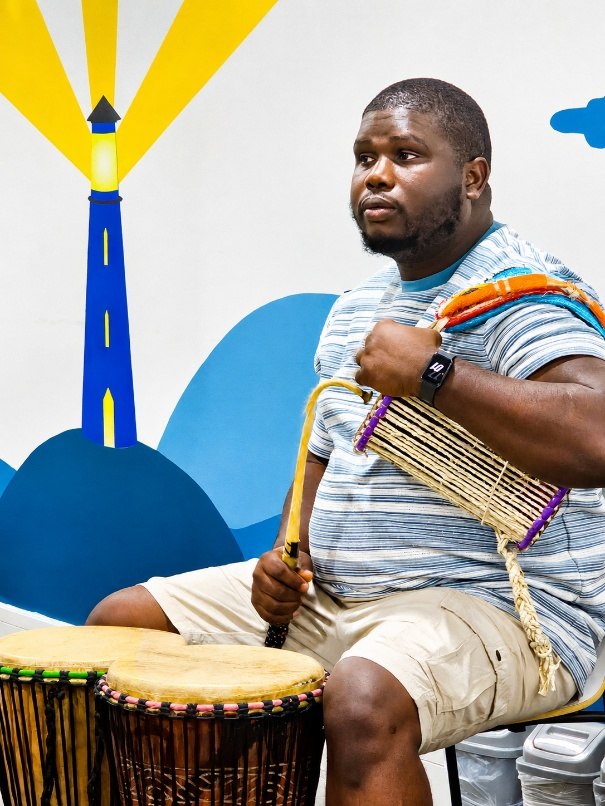
There is an old idea, held across many West African cultures, that all some instruments do is to speak. The talking drum is the clearest example of this. Its pitch bends and stretches to mimic the tone and tempo of human speech, so that in the right hands, a drum stops being percussion and becomes a sentence. It can greet you. It can praise you. It can also tell you who your ancestors were. This is craft, passed down, practised, and understood by very few people fluently enough to make a room full of strangers feel addressed.
Hammed Adeniji is one of those few. And yet, on most days, you would not know it.
By day, Hammed works as a carer. This is perhaps unglamorous, necessary work that is plausibly more about patience and presence than performance. It is equally, on the surface, as far from the stage as a life can get. But spend enough time around him, or better still, near him when he is behind a talking drum, and the distance collapses. The same attentiveness that care work demands, the reading of another person’s needs before they are spoken, is the same instinct he brings to an audience. He is, by his own account, someone who believes in service before spectacle. That difference shapes how his story should be told. He is not chasing a stage. However, this is the story of a man who has been fluent in a language most people cannot hear since before he had a name for it, and who has spent years finding room for that language alongside a life built on quieter forms of service. “Music is what I do,” he says, “but it isn’t all that I am.”
Meeting Hammed Adeniji…
Hammed Adeniji is an indigene of Ijebu Imusin in Ogun State, Nigeria, raised in a close-knit family of six. His earliest memory of the talking drum is not of learning it but of hearing it during traditional ceremonies in his community, where the drum communicated, praised people, or told stories. He remembers being fascinated less by the rhythm than by the illusion of speech itself, the sense that the drum was saying something specific to someone specific. “Not only does it give melodious rhythms to music,” he says, “it also has a way of talking to its audience.” That is what captured him. That fascination stayed with him long enough to become an apprenticeship. He learned, as he puts it, through “observation, practice, listening, and constant improvement,” under drummers who understood the instrument as discipline and cultural inheritance rather than entertainment. Even now, he says, “I still consider myself a student, because our traditions are rich and there is always more to learn.”
His path there was not direct, at least not on paper. He studied Estate Management, earning a National Diploma and Higher National Diploma before completing a Bachelor of Technology in the same field at Bells University, Ota. But even inside that academic track, the cultural pull persisted. As a student, he joined the Ijebu Students’ Association, an organisation built around preserving Ijebu culture and tradition, and rose through its ranks to become Campus President in his final year. It is tempting to read this as a detour from his creative path. It reads more accurately as the moment the two threads of his life, structure and culture, formal training and inherited tradition, first sat comfortably in the same hands.
The turning point, when the drum stopped being something he did well and became something closer to a calling, arrived quietly. “My performances were touching lives beyond entertainment,” he says of the moment things shifted. Invitations to cultural festivals, educational programmes, and international events began arriving, and with them, a kind of confirmation. When he plays now, he describes the feeling in almost private terms: “It’s a way for me to express and release a good aura to my audience. When I’m on it, it feels like I’m in my own cloud.”
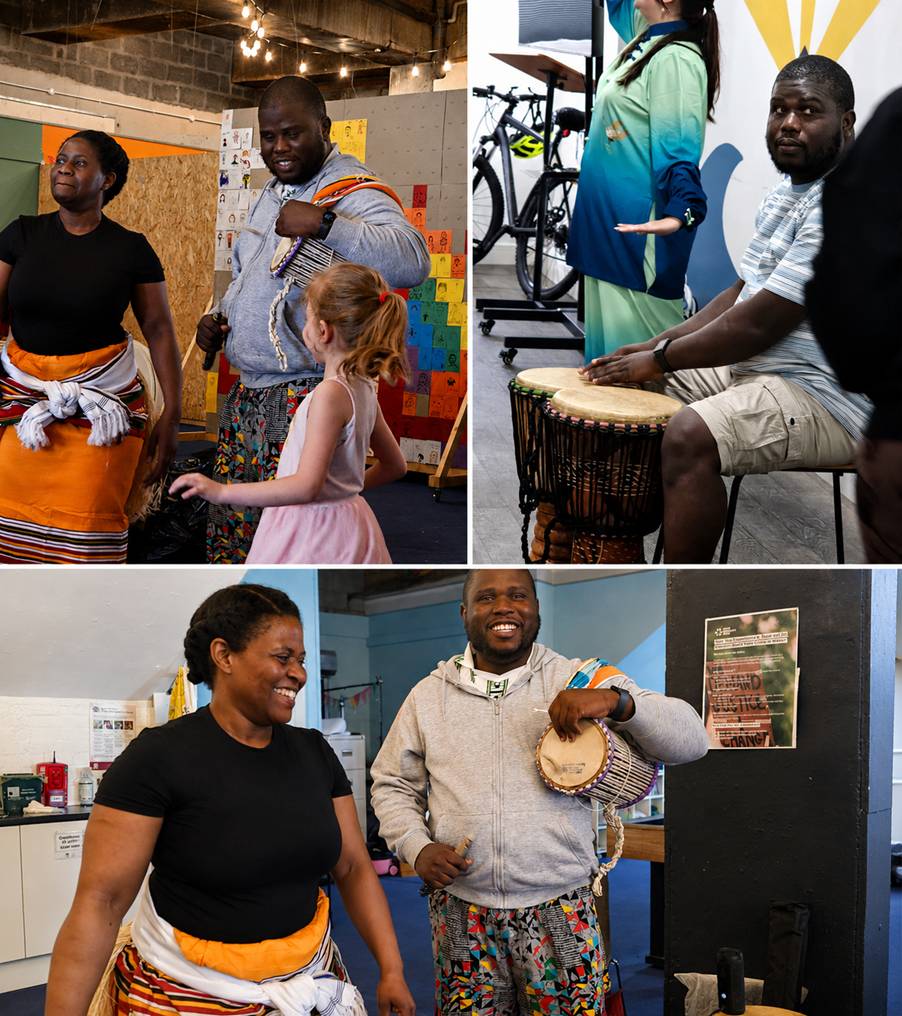
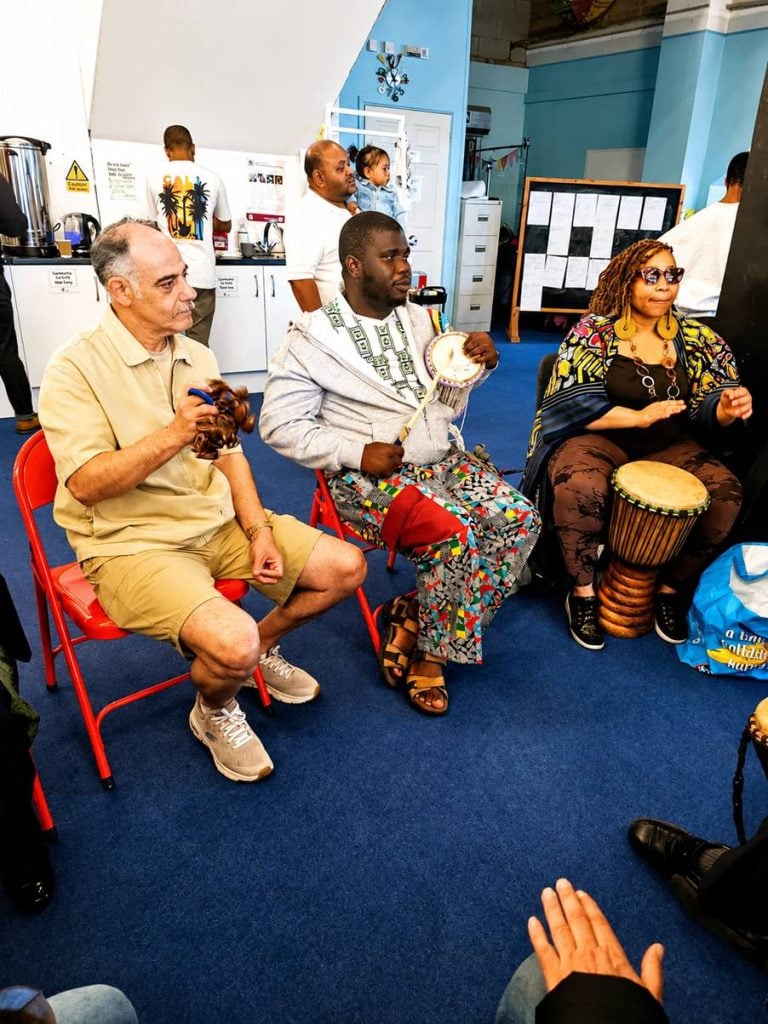
From there, the creative commitment deepened. In Lagos, he trained and performed with the Footprints of David Art Academy and the Guild of Nigerian Dancers, immersing himself further in the technical and cultural discipline the talking drum demands. When he relocated to the UK, he continued that work with Nganga Performing Arts and Mobile Theatre, the cultural performance arm of the C3 Centre for Creativity and Culture, based in Wales. It is here that his role shifts slightly, from performer to translator. In Nigeria, audiences already understand what a talking drum is doing, even if they cannot articulate it. In the UK, he is often introducing the instrument for the first time. “I’m not just performing rhythm,” he says, “I’m translating a tradition.” That act of translation, adapting the instrument’s traditional register to unfamiliar audiences without diluting its meaning, is, in his words, “a kind of fluency in code-switching between the traditional and the contemporary.”
Hammed’s presence in the UK’s creative and cultural space is evident not only in his technical command of an instrument few can play, but also in his refusal to treat it as belonging to one audience. Though Yoruba himself, he performs comfortably in Igbo cultural settings and at multicultural events, guided, he says, by a simple principle: respect for the culture being represented and a belief that “African culture is something that unites rather than divides.” Being Yoruba, he says, has taught him that “music is never separate from life,” that in his culture it “celebrates joy, honours people, preserves history, and accompanies important life events.”
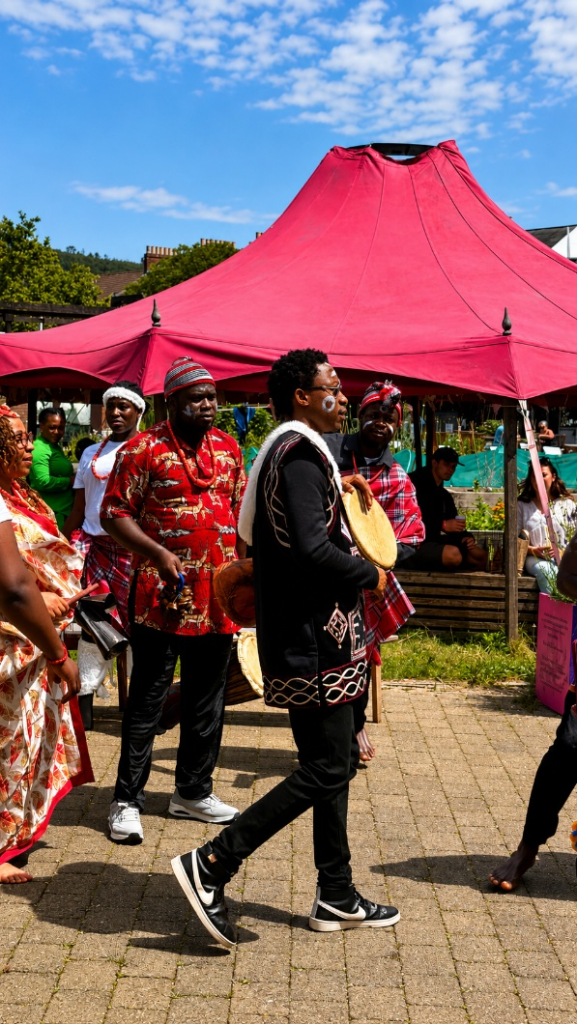
That instinct extends beyond ethnicity into purpose. Hammed speaks openly about mental health advocacy, framing his drumming not as separate from that cause but as an earlier, wordless version of it. “Mental health advocacy,” he says, “is just naming out loud what the drum has always been doing quietly,” pointing to the visible release he has watched settle over crowds when a rhythm locks into place. He is also quick to correct a common misreading of his craft. “Many people assume traditional African percussion is simply loud entertainment,” he says. “In reality, every rhythm has meaning, structure, history, and purpose.” It requires, he insists, “years of discipline and mastery, just like any classical musical tradition.”
He recalls one performance in particular, after which someone approached him in tears, telling him the music had returned them, briefly, to memories of home they had not revisited in years. It is the kind of moment that clarifies, for him, why he continues. This is about the connection to homeland, family and the broader community.
It is worth naming plainly the space Hammed is working within. African percussion remains a relatively young presence in much of the UK’s cultural space, more often encountered at heritage months and multicultural showcases than embedded in the everyday cultural calendar, as classical or jazz traditions are. This marks an early stage of arrival, the point at which every tradition passes before audiences come to understand it on its own terms rather than as an occasional guest. That moment calls for practitioners willing to do the patient, continued work of translation, performance by performance, until an instrument that once needed introducing begins to speak for itself.
This is the quieter cultural argument his career makes, spoken or unspoken. A tradition earns permanence by being practised, taught, and encountered often enough that audiences grow fluent in it. Hammed carries out this work while clocking hours as a carer, building his stage himself rather than waiting for one to be built for him, which is a bold proof of how early this moment still is for African percussion in Britain, and how much of the groundwork rests with individuals like him. He is actively making the case for it, one performance, one newly attentive audience, at a time.
There is also an insistence in how Hammed frames his own ambitions, one that mirrors the care work occupying the other half of his life: that the value of what he does is measured less in visibility than in what it restores to the people encountering it. Community, memory, identity, calm. He is not building a brand. He is preserving and teaching a language, one performance at a time, to rooms that did not know they were fluent in it, too.
When people hear the name Hammed Adeniji, he hopes they remember a man who honoured his culture, served people with humility, and proved that African rhythm is not only something we hear, but something we feel, something we carry, and something with the power to bring the world together.
The drum, in his hands, is still speaking.
Chinyere Chukwudi-Okeh is a writer-critic and reviewer of arts, culture, and literary artists and productions.
WATCH TOP VIDEOS FROM NIGERIAN TRIBUNE TV
- Relationship Hangout: Public vs Private Proposals – Which Truly Wins in Love?
- “No” Is a Complete Sentence: Why You Should Stop Feeling Guilty
- Relationship Hangout: Friendship Talk 2025 – How to Be a Good Friend & Big Questions on Friendship
- Police Overpower Armed Robbers in Ibadan After Fierce Struggle


