
Surveyors in Nigeria have been urged to adopt comprehensive security and occupational health measures to protect practitioners from kidnapping, violence and other risks associated with field assignments.
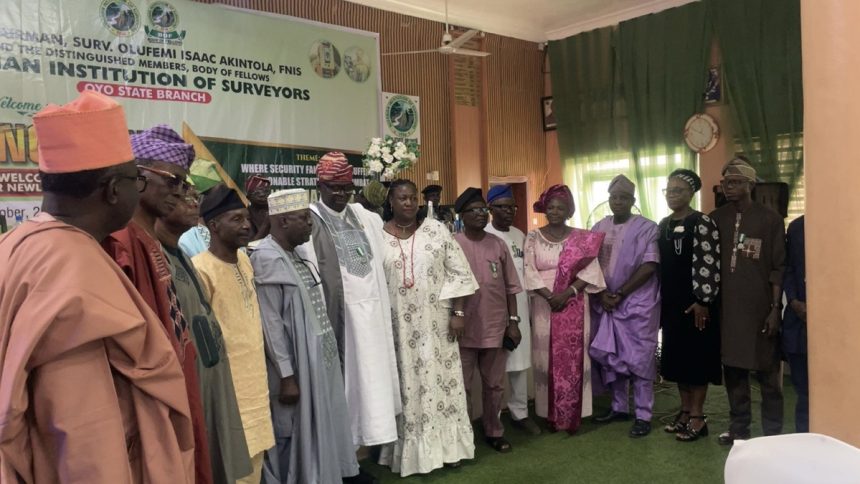
A professor at the University of Ibadan’s Institute for Peace and Strategic Studies, Isaac Olawale Albert, made the call while addressing members of the Nigerian Institution of Surveyors (NIS) at the 2026 annual luncheon and welcome ceremony for newly invested fellows of the Body of Fellows, Oyo State branch.
The event, held at the NIS Plaza, Ikolaba, Ibadan, on Thursday, featured discussions on the health risks posed by insecurity and the need for stronger safety measures in surveying practice.
In a presentation titled “When Safety Fails, Health Suffers: Addressing the Health Hazards of Insecurity,” Albert said insecurity should be treated as an occupational health issue because of its potential impact on surveyors’ physical and mental wellbeing, professional performance and livelihoods.
He noted that surveyors often arrive at project sites before protective infrastructure, security posts and other facilities are put in place, leaving them vulnerable to threats, particularly in remote or disputed locations.
According to him, the profession’s involvement in boundary demarcation, road construction, pipelines, buildings and land administration exposes practitioners to environments where disputes, criminal activities and inadequate security could threaten their safety.
Albert identified physical injuries, abduction, delayed medical treatment, psychological distress, sleep disturbances and loss of income as some of the consequences of insecurity. He added that the effects could persist even after victims had been released or physically recovered.
Citing reported incidents involving surveying personnel in Ondo State, the Federal Capital Territory, Ogun State and the Niger Delta, he stressed the need for firms to conduct security assessments before deploying workers to the field.
The professor urged surveying firms to introduce written field-security and occupational health policies, conduct mandatory risk assessments for high-risk assignments, provide emergency medical arrangements and insurance, and establish confidential channels for reporting threats and near-misses.
He also called for training in first aid, communication, conflict sensitivity and psychological first aid, as well as adequate funding for safety measures in project contracts and budgets.
Albert urged the NIS to lead the development of minimum field-security and occupational health standards for the profession, provide model risk-assessment and incident-reporting templates, and incorporate security and health awareness into its continuing professional development programmes.
He proposed a framework tagged S.A.F.E.R., representing Scan, Authorise, Field-protect, Escalate, and Recover and Review, as a practical guide for managing risks before, during and after field assignments.
He explained that the framework would require practitioners to assess locations and potential threats, obtain appropriate authorisation before deployment, provide protective equipment and communication systems, respond promptly when conditions deteriorate, and ensure adequate support for recovery after incidents.
He maintained that technical accuracy should not take precedence over personnel safety, stressing that practitioners should have the authority to postpone or terminate assignments where risks remained unacceptable.
Earlier, the Chairman of the Oyo State Body of Fellows of the NIS, Surv. Olufemi Akintola, described surveying and mapping as a noble profession built on trust, integrity and honour.
He urged both senior and junior members to uphold the profession’s core values, adding that recommendations from the programme would be considered holistically to guide appropriate decisions.
A newly invested fellow, Surv. Ekpo Effiong, expressed appreciation to the Oyo State Body of Fellows for organising a reception in his honour, six months after his investiture in Abuja.
Effiong, who is the Deputy Rector of the Federal School of Surveying, said he expected to contribute more to training and professional development, as well as efforts to advance surveying and geoinformatics in Nigeria.
He commended members for their support, describing the reception as a demonstration of their commitment to the profession and the fellowship.
He pledged to help raise professional standards, promote exemplary leadership and strengthen the institution.
The event featured presentations by the Young Surveyors Network, Women in Surveying, delegates from different parts of the country and other stakeholders.
WATCH TOP VIDEOS FROM NIGERIAN TRIBUNE TV
- Relationship Hangout: Public vs Private Proposals – Which Truly Wins in Love?
- “No” Is a Complete Sentence: Why You Should Stop Feeling Guilty
- Relationship Hangout: Friendship Talk 2025 – How to Be a Good Friend & Big Questions on Friendship
- Police Overpower Armed Robbers in Ibadan After Fierce Struggle


