
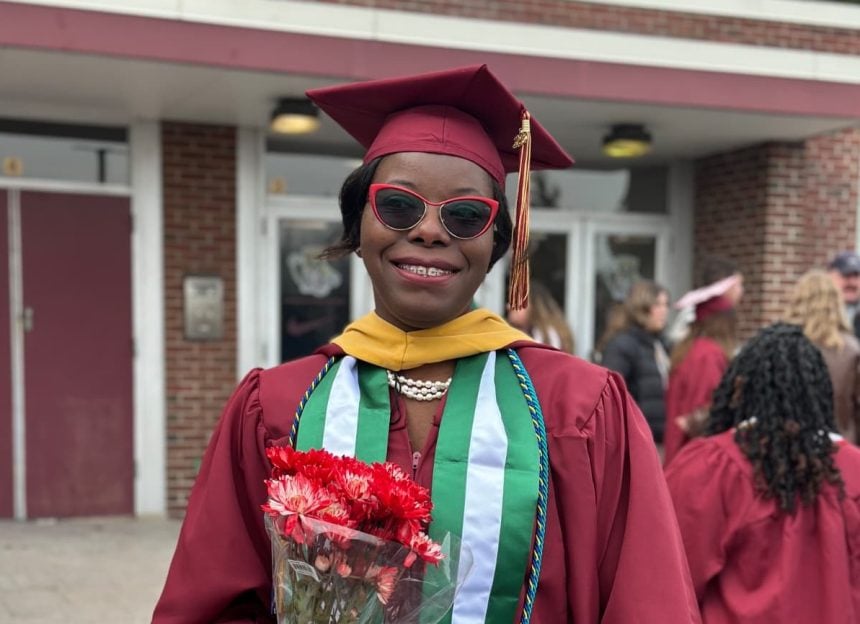
For Oyinkansola Simbiat Lawal, winning the ‘Social Work Prize: Celebrating Diversity’ was more than an award, it was a powerful affirmation of her identity, resilience, and releasing the self-doubt mindset. A Nigerian social work graduate and entrepreneur, Oyinkansola captured her journey of adapting to life in the United States through her award-winning project, Stitching Cultures.
In this interview, she reflects on her journey, the inspiration behind the project, the meaning of celebrating diversity, and the courage it took to put her story forward.
Beyond the name, who is Oyinkansola Simbiat Lawal?
My name is Ms Oyinkansola Simbiat Lawal, a native of Osogbo in Osun State, Nigeria.
I had my early education in Osogbo, from primary school through secondary school. I earned my bachelor’s degree in Physiology from Ladoke Akintola University of Technology (LAUTECH) in 2015, graduating with a second-class upper. I proceeded with the NYSC in 2016, after which I earned my Master’s in Public Health from the University of Ibadan, where I graduated with a distinction. My graduate degree in public health through research contributed to the body of literature regarding postpartum depression in the Nigerian context and suggested evidence-based approaches for supporting postpartum mothers.
Beyond academics, I established Loyabik Collections after my service year. It is a business venture where I teach women how to make and sell throw pillows and curtains and how to curate gift items. I ran the business alongside my master’s programme at the University of Ibadan.
In 2023, I left Nigeria to pursue a Master of Social Work at Kutztown University in the United States. Studying social work allowed me to build on my previous training in physiology and public health while developing a deeper understanding of how social, cultural and systemic factors affect people’s health and well-being.
Studying internationally had been a long-held dream. I received my first opportunity for international study in 2017, but I lost my father that year and had to put that dream on hold. Six years later, in 2023, I was finally able to pursue it.
Congratulations on winning the Kutztown Social Work Department Prize: Celebrating Diversity! Can you share with us how you first heard about this award and what motivated you to apply?
Thank you. I heard about the award through a general announcement sent to our emails by the department.
I looked at the criteria for applying, but I initially dismissed the idea because of the mindset that “I may not win” and “I’m just an international student; they may not consider whatever I write.”
Later in the spring semester, they made another announcement during a professional development meeting, saying they were still expecting entries. They encouraged people to apply and even emphasized that the project did not have to be perfect to be considered.
At that moment, although I thought about the money involved, the money wasn’t what motivated me. Rather, I was determined to kill the mindset that had been holding me back, the mindset of not putting myself out there even when I knew I had what it takes.
In addition, I went through the catalogue of previous winners and saw what they had presented. I read the criteria for selection, which included being a master’s student and reviewed by a faculty committee. I said to myself, “My project could be among the best if I can bring my thoughts together and submit it for consideration.”
What does being a recipient of the award mean to you personally and professionally?
Personally, receiving the award was an honour and a testament to the fact that I should always believe in myself. In addition, the award gave me a bigger community, and I get to share my story as a Nigerian and an African.
Professionally, the award was about celebrating the interpretation of diversity from personal experience. In addition to my classroom teachings and practical experiences in the field, I have come to understand that diversity isn’t just about what defines us; we are living it.
That knowledge is something I apply when interacting with the populations I work with and with everyone around me.
Are you the first Nigerian to win the award in your department or there have been past recipients from Nigeria?
Based on the department’s publicly available list of previous recipients, I have not identified an earlier Nigerian recipient.
Your project is titled “Stitching Cultures.” That’s a very evocative name. Can you tell us the story behind that title?
Hmm. The name came from my skill as a throw-pillow and curtain maker. You know, for you to join two things together, you need a stitch.
So, I wanted my project title to exude that version of me outside of academics while incorporating and explaining my diversity from personal experience.
Since my project was going to be about my journey and how I am adapting to the culture of where I came from, Nigeria, and the culture of the USA where I am, currently, the name for the project couldn’t have been anything else.
What was the central message or theme of “Stitching Cultures”? How did you go about expressing that message?
The overarching theme of the project was celebrating diversity from your personal experience.
With my title, I did my project in a picture-and-word format. I started with a story and a picture showing when I left Murtala Muhammed Airport in 2023. I talked about the challenges of adapting to a new culture and eventually delved into how I was able to turn those challenges into my strength.
One thing my social work journey has taught me is that, in every individual, there is always an inherent strength that you can build on in the midst of deficits.
And, as you know, Niger no dey carry last. The resilience and resourcefulness of being a Nigerian were part of what carried me through the journey so far.
The award focuses on how students express what celebrating diversity means to them. How do you define “celebrating diversity” in your own words?
In my own words, celebrating diversity means actively honouring and uplifting the rich variety of our identities and the various cultures that make up our shared human experience.
As someone rooted in Nigerian heritage, celebrating diversity to me means embracing my cultural roots, identifying with them, and sharing perspectives from the Nigerian viewpoint whenever we have discussions in class.
I dress in a Nigerian way as much as I can, and my professors and classmates appreciate the international perspective I bring to discussions.
Another way I would define celebrating diversity, which my project expressed, is bringing attention to the fact that other students, especially international students who may not necessarily be from Nigeria, need to be heard and seen. Adapting to a new culture takes time, and there is therefore a need for patience and understanding when dealing with us.
How has your understanding of your own identity evolved from your time at Kutztown University, especially during the social work programme?
Attending Kutztown University as a Nigerian and an international student, I initially saw my identity primarily through a cultural lens. However, being part of the social work programme expanded my understanding and perspective of identity in various ways.
Through coursework, field experiences, and interactions with diverse peers and faculty, I understood identity as a dynamic and multilayered concept.
I’ve had to reflect on my own cultural values, biases, and assumptions, especially in the context of working with populations whose experiences differ greatly from mine.
One of the most significant changes has been learning to see myself not as an outsider, but as someone with a unique perspective and strength to bring into the profession.
I’ve learned to balance pride in my heritage with humility and openness to other people’s stories and struggles.
The programme has also encouraged me to critically reflect on systems of power, privilege, and oppression in my home country and globally. That is helping me as I continue my journey as a future multidisciplinary professional and someone who is more committed to justice, equity, and culturally competent practice.
Can you share a specific moment, either from your project or your academic journey, where you felt deeply connected to the idea of cultural diversity?
During my second semester, in Spring 2024, I participated in a cultural event as part of the African Student Association on campus. We organised the event and tagged it Experience Africa.
It was a night of interaction and teaching the audience about our cultures through food, clothing, music, and greetings.
The highlight of the event was a drama about a wedding involving a Ghanaian who wanted to get married to a Nigerian girl. It was a night of storytelling and bringing out the beauty of our cultures to the American audience on campus.
The result was lively engagement and honest curiosity.
After the event, so many people approached other African students and me to greet us and tell us how much they liked our culture and its richness. Many times, I also get approached about my dressing and receive compliments.
Those moments crystallised for me that cultural diversity truly thrives through intentional connection and shared stories.
What was the creative or academic process like for putting “Stitching Cultures” together? Were there any challenges or moments of growth?
You won’t believe it if I told you that putting the Stitching Cultures project together took me about five hours to draft.
I came back from an evening class around 9 p.m., had a quick snack, and started working on it. I knew what I wanted to put in the project, so that made it easier.
I didn’t have the right words at first, but I wrote down what came to me at that moment. I slept around 3 a.m., and the next day, I sent the draft I made to my sister, Kehinde Lawal, a first-class English graduate from OAU.
Aside from using apps like Grammarly to correct documents, she always helps make my documents and essays more coherent and ensures they have a good flow of thought.
There weren’t any challenges, honestly. It was an easy-peasy project because I was determined to put myself out there, even if I didn’t win eventually.
The only challenge would have been if I didn’t eventually submit it. And that would also mean I wouldn’t be here today talking about the project with you.
Did you collaborate with others or gather input somewhere during the project? If so, what was that experience like?
No, I didn’t. It was an individual project.
Aside from myself and my sister, who helped with the grammar and arrangement of the draft, I sent it to a friend, Adetola Ajayi, to review before I finally submitted it.
What kind of response did you receive from faculty, peers, or the Kutztown University community after winning the award?
Looking back now, I always laugh when I remember it because, suddenly, I became quite popular.
I remember writing a self-reflection paper assignment that was due the following Sunday after I got the award, and I indicated that I was called “Star Girl.”
It was humbling at the same time as it was an honour.
I received emails from lecturers who read my project at their leisure. I also got featured in Kutztown University’s daily brief. I didn’t even know about it; someone called my attention to it during a Zoom class by sending me a direct message.
I received so many congratulatory messages, even from my work director, who said she was proud to have me on her team and would miss me when I graduated.
I was really proud of myself and am glad I fought through the storms to be living in this dream I had dreamed of for a long time.
After the award, I birthed a new collection of throw pillows, which I named Rooted Elegance.
How do you think social workers can play a stronger role in celebrating and advocating for diversity in their communities?
I believe we social workers can play a stronger role in celebrating and advocating for diversity by moving beyond performative gestures to actively creating space for underrepresented voices.
This means amplifying lived experiences, continually addressing systemic barriers, and ensuring that interventions are not one-size-fits-all but instead culturally responsive and community-informed.
Ultimately, our role is not only to recognise diversity but to honour it through practice, policy, and presence, to stand with, not just for, the people we serve.
Do you think Kutztown’s social work department is doing enough to promote diversity and inclusion? How could it continue to grow in that area?
Yes, definitely, they are.
The department’s commitment to diversity is evident. One example is the Diversity Project Award. That project gave me a platform to share my cultural background, highlight its beauty, showcase the values I carry, and explain the differences I bring into my new world.
While there is room for more to be done, I believe greater inclusion can be fostered, and integration of global perspectives and immigrant narratives into discussions, as well as culturally competent frameworks to learn from, would help prepare students to serve an increasingly diverse population.
How did winning the award and working on “Stitching Cultures” shape your future goals in social work?
It made me appreciate myself more and have a greater belief in what I can do.
Through the Stitching Cultures project, I’ve seen firsthand how the power of storytelling and authentic cultural exchange can pave the way for stronger, more connected communities.
The experience will follow me throughout my journey in designing interventions that centre on the unique stories and needs of diverse groups.
What are you doing now, and how have these experiences influenced the work you hope to contribute to healthcare and social work?
Since completing my Master of Social Work, I have continued building my career in healthcare social work and currently work as an inpatient social work case manager in a hospital. My work involves supporting patients and families through complex hospital transitions, including psychosocial assessment, discharge planning, resource coordination, advocacy, and addressing barriers that can make it difficult for patients to transition safely from the hospital to the next level of care.
My past and ongoing professional experiences continue to strengthen my interest in developing practical approaches that combine social work, care coordination, and appropriate use of technology to improve continuity of care.
My long-term goal as an interdisciplinary professional who sees problems from different perspectives is to continue contributing to healthcare through practice, research, and the development of solutions that help vulnerable populations navigate complex systems more effectively.
Do you have any advice for future Nigerian students who might be thinking of applying for this award? Or for other international students or professionals seeking to make meaningful change abroad?
Start with your story.
Embrace your identity and let it be your strength. The challenges of adapting to a new country are real, but they also sharpen your ability to innovate and lead.
Most importantly, do not disqualify yourself before anyone else has had the opportunity to consider you. That was the lesson this award taught me. I nearly allowed the thought, “I may not win,” to stop me from submitting something I knew represented me well.
Believe in yourself first and believe that your dreams are valid. Prepare for the opportunities you want, and be willing to put your work forward. Some people may think your dreams are too big, but with consistency, preparation, and courage, you may eventually find yourself living inside a dream you once thought was beyond your reach.
For me, “Stitching Cultures” started as a five-hour project despite coming back from a long day. It became an award, with my name on the departmental award recognition wall, a platform to tell my story, and a reminder that sometimes the first person you have to convince that you belong in the room is yourself.
WATCH TOP VIDEOS FROM NIGERIAN TRIBUNE TV
- Relationship Hangout: Public vs Private Proposals – Which Truly Wins in Love?
- “No” Is a Complete Sentence: Why You Should Stop Feeling Guilty
- Relationship Hangout: Friendship Talk 2025 – How to Be a Good Friend & Big Questions on Friendship
- Police Overpower Armed Robbers in Ibadan After Fierce Struggle


