
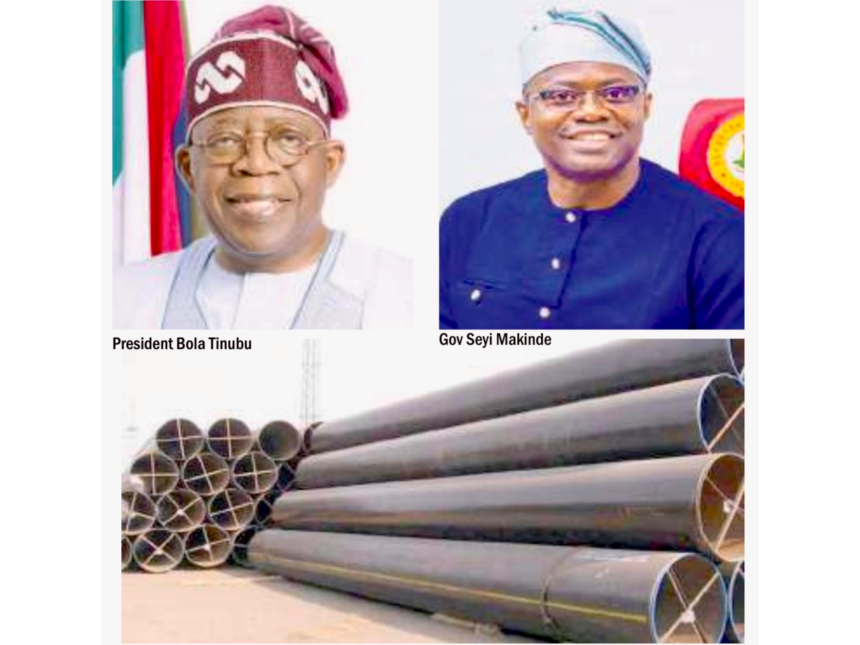
THE recent completion of the River Niger crossing segment of the Obiafu-Obrikom-Oben (OB3) gas pipeline by NNPC Gas Infrastructure Company (NGIC), a subsidiary of the Nigerian National Petroleum Company Limited (NNPC Ltd), has been widely celebrated as a major breakthrough in Nigeria’s quest to expand gas infrastructure and strengthen domestic energy supply.
After years of delays caused largely by the engineering complexities associated with crossing the River Niger, the successful completion of the 130-kilometre pipeline is expected to significantly improve gas transportation capacity across the country. According to NNPC, the OB3 pipeline has the capacity to transport up to two billion standard cubic feet of gas per day, enhancing energy security and supporting economic growth.
However, while the OB3 project signals progress in one part of the country’s gas infrastructure agenda, another major gas project in the South-West has become the centre of an increasingly contentious dispute with potentially significant implications for industrial development, investment confidence and regulatory certainty.
The 80-kilometre Sagamu-Ibadan gas pipeline project, being developed by NIPCO Gas Limited in partnership with NNPC Gas Marketing Limited (NGML), has remained stalled for more than five months, following a stop-work order issued by the Oyo State government in December 2025.
Industry stakeholders warn that the prolonged suspension of the project could undermine efforts to expand domestic gas utilisation and support industrial growth along one of Nigeria’s most important economic corridors.
Designed to transport natural gas from Sagamu in Ogun State to Ibadan in Oyo State, the pipeline forms a critical component of the nation’s gas distribution network and is expected to supply industries, commercial users and other consumers across the region.
ALSO READ: Kwankwaso won’t be ‘spare tyre’ as my VP if I become president — Peter Obi
The project was conceived as a strategic intervention to address energy challenges faced by manufacturers operating within the Lagos-Ibadan industrial corridor, one of the country’s largest manufacturing hubs.
Energy analysts note that natural gas remains one of the most cost-effective energy sources available to industries, particularly at a time when manufacturers continue to struggle with high electricity costs, unreliable grid supply and rising diesel prices.
According to industry sources, more than $100 million has already been invested in the Sagamu-Ibadan pipeline project. The expenditure covers pipeline procurement, right-of-way acquisition, engineering activities, mobilization and other preparatory work.
Stakeholders fear that every additional month of inactivity could increase project costs through demobilisation and remobilisation expenses, contract adjustments, financing charges and other unforeseen liabilities.
The project is being executed under a 25-year Gas Distribution Licence issued by the Nigerian Midstream and Downstream Petroleum Regulatory Authority (NMDPRA) in accordance with the provisions of the Petroleum Industry Act (PIA).
For many observers, the dispute surrounding the project extends beyond a simple disagreement between a project developer and a state government. Rather, it raises broader questions about the relationship between federal regulatory authority and state-level interests in the implementation of major infrastructure projects.
Industry experts argue that delays affecting projects backed by federal licences could send negative signals to investors, particularly at a time when Nigeria is actively seeking billions of dollars in investments to expand its gas infrastructure and support the Federal Government’s gas-based industrialisation agenda.
The immediate economic consequences are already becoming evident.
Manufacturers operating within the Ibadan-Ogere-Oluyole industrial corridor continue to rely heavily on diesel-powered generators and electricity from the national grid. Industry operators say the absence of pipeline gas keeps production costs elevated and limits the competitiveness of locally manufactured goods.
Several industries, including food processing companies, agro-allied firms, ceramic manufacturers and beverage producers, had reportedly incorporated access to natural gas into their medium-term expansion strategies.
Stakeholders believe that delays in pipeline completion could postpone investments, reduce projected industrial output and slow job creation opportunities that were expected to emerge from expanded gas access.
The pipeline is also considered important to the Federal Government’s broader energy transition objectives, including the Presidential Compressed Natural Gas (CNG) Initiative aimed at promoting cleaner transportation fuels and reducing dependence on conventional petroleum products.
Energy sector analysts argue that gas distribution infrastructure is just as important as upstream gas production in achieving national energy goals.
While Nigeria possesses some of the largest natural gas reserves in Africa, experts note that the challenge has often been connecting available gas supplies to end-users through efficient transportation and distribution networks.
Projects such as the Sagamu-Ibadan pipeline therefore serve as essential links between gas producers and industrial consumers.
According to analysts, uncertainty surrounding such projects could discourage future investments across the gas value chain, including upstream production, processing facilities and distribution infrastructure.
The dispute that led to the suspension of construction has centred largely on regulatory and commercial considerations.
Investigations by the Nigerian Tribune indicate that following the issuance of the stop-work order, representatives of NIPCO Gas Limited and the Oyo State Government held a series of meetings aimed at finding a mutually acceptable solution and facilitating the resumption of construction activities.
However, the discussions reportedly failed to produce a conclusive resolution.
Sources familiar with the negotiations disclosed that one of the key issues involved proposals by the state government for Shell Nigeria Gas (SNG) to participate in aspects of gas distribution infrastructure development within the state.
According to the sources, NIPCO Gas Limited rejected the proposal, arguing that the Gas Distribution Licence issued by the NMDPRA provides the legal basis for the project and does not contemplate the inclusion of another operator within the licensed distribution arrangement.
The disagreement subsequently led to exchanges of correspondence between the parties as they sought to defend their respective positions regarding the future of gas distribution infrastructure in the state.
Speaking on the matter, petroleum engineer and energy policy expert, Joseph E. Nwakwue, described the situation as unusual and stressed the importance of regulatory clarity.
Nwakwue noted that while he was not fully acquainted with all the details of the dispute, the NMDPRA remains the statutory regulator responsible for issuing licences within the midstream and downstream petroleum sectors.
“I am not familiar with the issues with the suspension of the NIPCO pipeline project. I suspect there might be some local or regulatory issues,” he said.
“NMDPRA has responsibility for licencing. The state government is not the regulator. Like I said earlier, it is difficult to comment when all the facts are not available.”
He further observed that the Petroleum Industry Act provides a comprehensive regulatory framework for operators and investors.
“The PIA has outlined a robust regulatory framework that operators should comply with. Where there are challenges with compliance, we expect that stakeholder consultation and alignment are required to ensure investments are not de-incentivized,” he added.
Responding to concerns raised by stakeholders, the state government has maintained that its actions are guided by strategic, regulatory and investment-protection considerations rather than opposition to private sector participation.
The Commissioner for Energy and Mineral Resources, Professor Dahud Shangodoyin, said the administration of Governor Seyi Makinde remains committed to attracting investments capable of promoting industrialisation, energy access and economic development.
He said the state government recognises the importance of gas infrastructure to economic growth and has consistently supported initiatives aimed at expanding cleaner energy access.
Shangodoyin explained that the state previously entered into a Memorandum of Understanding with Shell Nigeria Gas concerning gas infrastructure development within the state.
He said the arrangement formed part of a broader strategy designed to ensure coordinated development of gas infrastructure and prevent duplication of investments.
“The Oyo State government, through the Ministry of Energy and Mineral Resources, has consistently supported investments capable of deepening energy access, industrialisation, cleaner fuel transition and economic growth within the state,” he said.
“We recognise the enormous benefits that gas infrastructure development can bring to industries, businesses, transport systems and households,” he said.
The commissioner noted that prospective investors are expected to align with the state’s broader development framework to ensure orderly infrastructure expansion and avoid conflicts that could affect long-term investment stability.
According to him, concerns have been raised regarding the potential for market dominance and the need to accommodate existing state-backed investment arrangements.
He disclosed that the government formally communicated its position to the NMDPRA and that federal officials have visited relevant project sites as part of ongoing fact-finding efforts.
Shangodoyin acknowledged that several meetings involving the state government, Shell Nigeria Gas and NIPCO Gas Limited have taken place but that the engagements have not yet yielded a satisfactory outcome.
“The challenge remains that NIPCO Gas appears unwilling to work within a coordinated framework that accommodates existing state-backed infrastructure arrangements and investment understandings,” he said.
“Their posture suggests an attempt to dominate and monopolise the gas distribution market within Oyo State despite commitments already established between OYSG and SNG,” he said.
The commissioner also argued that federal licencing powers do not eliminate the constitutional responsibilities of state governments in areas such as land administration, physical planning, environmental management and infrastructure coordination.
“It must also be emphasised that licencing authority under federal law does not remove the constitutional responsibilities of state governments regarding land administration, physical planning, infrastructure coordination, environmental management and protection of strategic economic interests within their territories,” he stated.
“Therefore, any temporary regulatory or administrative actions taken by relevant state agencies should not be misrepresented as anti-investment or politically motivated,” he said.
He expressed confidence that ongoing engagements involving the NMDPRA and other stakeholders would eventually produce a mutually acceptable resolution.
Meanwhile, industry sources familiar with the project insist that NIPCO Gas Limited remains committed to implementing the project in accordance with the Gas Distribution Licence granted by the NMDPRA.
The company is understood to believe that altering the existing licensing framework could expose it to contractual risks and undermine regulatory certainty within the sector.
Sources also indicate that substantial progress has been made on associated gas distribution infrastructure before construction activities were suspended.
For industry observers, the dispute has become a significant test case for Nigeria’s gas sector reforms under the Petroleum Industry Act.
Many argue that the eventual resolution will shape investor perceptions regarding the enforceability of regulatory licences and the predictability of the investment environment.
With the project’s original completion date set for June 2026, stakeholders warn that prolonged delays could push commissioning into 2027 and postpone anticipated economic benefits.
As negotiations continue, attention remains focused on the NMDPRA, the state government and the project promoters to find a solution that balances regulatory compliance, investment protection and the broader objective of accelerating gas infrastructure development across Nigeria.
For a country seeking to position natural gas as the cornerstone of industrial growth and energy transition, the outcome of the Sagamu-Ibadan pipeline dispute may prove critical in determining how future infrastructure investments are perceived and executed.
WATCH TOP VIDEOS FROM NIGERIAN TRIBUNE TV
- Relationship Hangout: Public vs Private Proposals – Which Truly Wins in Love?
- “No” Is a Complete Sentence: Why You Should Stop Feeling Guilty
- Relationship Hangout: Friendship Talk 2025 – How to Be a Good Friend & Big Questions on Friendship
- Police Overpower Armed Robbers in Ibadan After Fierce Struggle


