
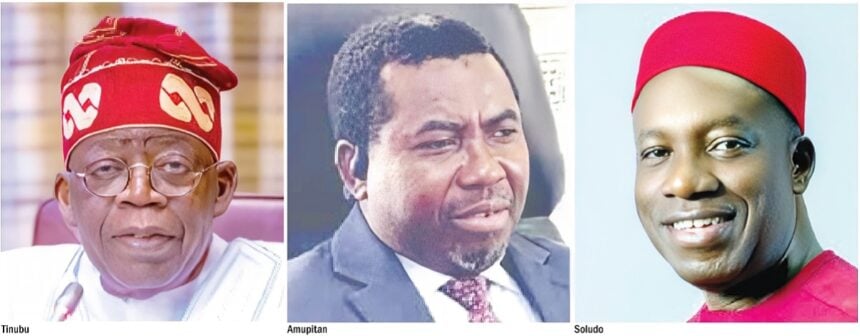
Governor Chukwuma Soludo of Anambra State was on Sunday, September 9, announced as the winner of the state’s governorship election held on November 8. The result of that election indicated a landslide victory for the former Governor of Nigeria’s Central Bank. In this report, General Editor, Politics, TAIWO ADISA, dissects the factors that stand out in the governor’s victory this time.
Before the Independent National Electoral Commission (INEC) opened the polling stations for voters to perform their civic duties in the Anambra governorship election on November 8, the general indication in the polity was that the governor would win a second term with less hassles and that the status quo would remain in terms of the structure of governance in the state. That projection was affirmed on Sunday, November 9, as the electoral body announced Soludo the winner of the governorship election, this time, winning with a remarkable landslide, and sweeping all the 21 local governments in the state.
According to the results released by INEC, Governor Soludo polled 422,664 votes to defeat his closest challenger, Nicholas Ukachukwu of the All Progressives Congress (APC), who recorded 99,445. Since the return of democratic governance in 1999, Soludo’s victory marked the first time a governorship candidate would sweep the polls in all the local governments of the usually politically volatile Anambra State. Political analysts would ascribe the feat to several reasons, including the unusually lukewarm campaign by the opposition parties this time, the body language of the ruling APC from Abuja, and the commotion in the house of the Peoples Democratic Party (PDP), which was the other party that occasionally springs surprises in the state.
Available data on the Anambra election shows that former governor, Petr Obi, the 2023 presidential candidate of the Labour Party (LP), was the biggest winner of the votes in the state. While his first coming as governor was blighted by legal disputes with PDP’s Andy Uba first snatching the victory in 2003, Obi recorded the highest votes in the 2007 election with a haul of 1,334,356 votes to clinch a second term in office. However, besides Obi, the elections had been a tug of war featuring Soludo’s All Progressives Grand Alliance (APGA), which was also Obi’s platform while in Anambra, and largely the PDP. In 1999, Governor Chinwoke Mbadinuju of the PDP won with 206,801 votes, defeating APGA’s candidate, Dr. Okey Onyenadum, and in 2003, records have it that PDP’s Chris Ngige won with 189,118 votes before he was eventually removed for Peter Obi, who was first sworn-in on March 17, 2006, impeached on November 3, 2006, and later reinstated on February 9, 2007, before he completed the first term in office. Obi won the most convincing victory in the 2007 polls with 1,334,356 votes. And completed his tenure on March 17, 2014. In the 2013 election, Obi’s successor, Willie Obiano, also of APGA, won with 656,987 votes to defeat PDP’s Tony Nwankwo. Obiano again won his second term in 2017 with 234,071 votes, to defeat the same PDP candidate, Tony Nwankwo. Soludo’s first arrival on the stage in 2012 showed him winning 19 local governments with 442,588 votes, to defeat PDP’s Valentine Ozigbo, while the former Central Bank Governor upped the ante in 2025 with a resounding victory that saw him winning all the 21 local governments.
Unlike the 2021 scenario, the election this time was less dramatic, at least in the usual colouration of Anambra. That is a state that usually presents two sets of winners got National Assembly elections, with one set serving two years and the other serving the remainder. That is also a state that is known for godfatherism and electoral form racketeering. In the 2021 election, which took place on 6 November 2021, and produced Soludo, the drama was around the dispute over the Ihiala election. The usual litigation over party primaries was present, with members of the PDP and the APC dragging themselves through the courts. The APGA and PDP members also accused themselves of holding multiple parallel primaries, leading to litigation, but INEC eventually recognized Soludo for APGA and Ozigbo as the PDP nominee after court orders.
Though the election was seen as being generally peaceful, the drama exploded in Ihiala, where election did not take place, forcing a repeat election that made the result inconclusive until a rescheduled election was held on November 9 and Soludo was declared the winner, polling 112,000 votes, which was 46.5% as PDP’s Ozigbo, who scored 54,000 votes, amounting to 22.3% of the votes.
The uniqueness of the November 8, 2025, election has been further reinforced by the fact that Soludo is the only Anambra governor to have won the 21 local governments since 1999. Records on the Anambra election indicate that the first governor of the Fourth Republic, Chinwoke Mbadinuju, who came in in 1999, won 14 of the 21 local governments, with Chris Ngige, who was later removed from office for Peter Obi winning 13 of the 21 local governments in 2003. In 2007, Peter Obi won 18 out of 21 councils, while his successor, Willie Obiano, won 20 of the 21 councils in 2013 and 17 of the 21 in 2017. In 2021, Soludo won 19 of the 21 councils, and to secure his second term, he cleared all 21 local governments.
Forces at Play
Several factors have been ascribed to the resounding victory recorded by Governor Soludo. Some political observers would say that the APC’s opposition got its wings clipped from the day its candidate, Nicholas Ukachukwu, emerged. It was said that the leadership of the APC had been in talks with Soludo to field a candidate whose wings won’t be difficult to clip and that the party’s primaries were staged in a way to produce the preferred candidate. Once Ukachukwu emerged as the party’s candidate, APC’s campaign became something close to a graveyard. Not much was heard from the campaign headquarters, and not much was heard from the APC. The usual drama that would involve APC leaders pulling their Babariga from the right and left to sweep through the streets for the final campaign rallies was absent. It was said that many of the South-East governors who were to mount the campaign podium to proclaim Ukachukwu’s candidature went silent, aside from projecting several excuses that made them stay away from Anambra. Some political stakeholders said that Ukachukwu’s complaint to some party chiefs about the lack of funding and activity around his campaign was creating the impression that his election had been ceded to Soludo was said to have been heard in the highest quarters, and the result of the said complaint was a further distance kept by the governors and party stakeholders from his campaign.
Incumbency Factor
Soludo was said to have leveraged on his incumbency to get everything to his advantage, and that was said to include his long-standing friendship with President Bola Tinubu. In the heat of the campaign, Soludo was seen on national television hosting Tinubu and wearing an Asoebi with the leader of the main opposition party. It was a bad signal to the APC, while the PDP had already gone comatose, not only in the state but also in the country. The incumbent governor was also able to mobilise better and was the most visible during the campaign. He was said to have announced a cash reward of N500 million for each of the local governments that voted massively for him.
Zoning Factor
Some sources in Anambra State also believed that the fact that Soludo is from the Southern Senatorial district of the state paid off for him, as the zone is seen as the rightful area to occupy the governorship seat at this time. It is also possible that the zonal impetus also got enormous goodwill into Soludo’s path, and he was able to market his achievements to the populace. Other factors said to have worked in his favour include huge elite endorsements with what was called a covert alliance with the ruling APC, while Soludo equally openly endorsed President Tinubu’s second-term aspiration. The fact that Soludo holds the key in Anambra State, the home state of a possible opponent of the president in the 2027 race, makes the state a strategic spot for the APC to perfect its gerrymandering skills. The governor also marketed his free education policy, which he said had already put Anambra at the pedestal of education achievements in the country, while also advertising his security initiatives as already ensuring peaceful coexistence in the state that was once the den of kidnappers and ritualists.
APGA Dominance
No doubt, Soludo’s victory in the November 8 election has once again extended APGA’s dominance in Anambra politics. Besides the 1999 election victory of Mbadinuju, the PDP had only sparingly touched the lever of power in that state. Some analysts would attribute this to the fact that the late Ikemba of Nnewi, Dim Odumegwu Ojukwu, hailed from the state and launched APGA as his party before his demise. While it is possible that APGA’s dominance in the state so far is credited to the late Ojukwu, other factors, including the party’s strong grassroots presence and deft political calculations by the different APGA candidates, have also helped. The fact that the opposition this time was, or weakened, something that has been referred to as federal backing for Soludo, is also a factor that cannot be ignored.
WATCH TOP VIDEOS FROM NIGERIAN TRIBUNE TV
- Relationship Hangout: Public vs Private Proposals – Which Truly Wins in Love?
- “No” Is a Complete Sentence: Why You Should Stop Feeling Guilty
- Relationship Hangout: Friendship Talk 2025 – How to Be a Good Friend & Big Questions on Friendship
- Police Overpower Armed Robbers in Ibadan After Fierce Struggle


