
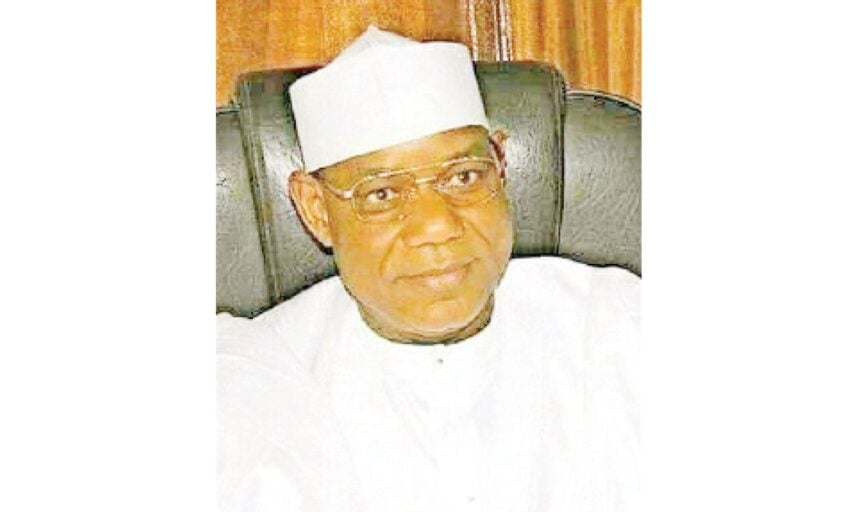
Professor Ahmed Alkali, former National Publicity Secretary of the Peoples Democratic Party and former Special Adviser on Political Affairs to former President Goodluck Jonathan, was also the pioneer National Chairman of the All Nigerian Peoples Party. A political scientist by training, he is now a chieftain of the All Progressives Congress (APC) in Gombe State. Amidst claims and counterclaims over alleged persecution of Christians in Nigeria and the threat of military action by United States President, Donald Trump, after designating Nigeria a “Country of Particular Concern,” Professor Alkali urges restraint on the part of the United States. In this interview by TAIWO AMODU, he says American belligerence will be counterproductive.
Penultimate week, the United States President, Donald Trump, designated Nigeria a Country of Particular Concern over alleged genocide against Christians. He has also suggested possible military action against militant groups in Nigeria. There are those who are cynical and have described US posturing as a facade to cover other sinister motives. What’s your take?
First of all, I think this is the first time in a very long time in the history of Nigeria that a foreign power is contemplating military action against us. It has not happened before. Secondly, we also know that since independence, Nigeria has maintained a close relationship and collaboration with the United States and Western Europe. Even during the Cold War era, when the USA and Western Europe were fighting with Russia, Nigeria still remained in the orbit of Western European countries. As you can see, our trade relationships, financial arrangements, even our students find themselves comfortable in those Western European countries and areas.
So, to most of us, we are shocked that the President of the United States at this stage will categorise Nigeria as a country fighting over religious or ethnic groups. In diplomacy, war is not the first option; it is the last option, if at all inevitable. Ordinarily, there should have been a lot of contact and consultations between Nigeria and the US. so that the issues are clearly defined.
What are the issues? It appears we have not clearly defined them, at least officially. Of course, we cannot deny that America has all the power, military and otherwise. We also know that America is facing a lot of opposition, a stiff competition with emerging nations. But Nigeria has not posed any significant threat. Nigeria did not attack any American interests. Nigeria did not fight anybody in the US. It is an internal matter.
The succeeding governments in this country have been doing their best. We know the general view is that yes, more could have been done to avoid casualties of every nature. Because one life lost—any life lost in Nigeria—is a loss to the country. First and foremost, the person is a Nigerian. Everybody has his own religion. That’s why I had to issue a statement to say that no, there must be certain things behind this American decision.
I documented them. One of them is the likelihood that Trump, knowing who he is, is dancing to the tune of his conservative evangelical base that always looks at religion as a primary factor both locally and internationally. America is also trying to push away the ongoing global narrative over what Israel has been doing in Palestine. I think it is something that has been condemned by everybody. But America does not see what Israel did in Gaza as wrong, and that surprises us. As a country that has been preaching human rights and equality for over 200 years, Gaza is where American attention should be.
You think American attention should be on what is happening in Gaza, but its focus is on Nigeria right now. What do you think should be done by the Nigerian government to change the narrative or placate the US?
No, no, no. I’m trying to build the trajectory. I have just mentioned two possible motivations. So we have to follow it through, because this is part of the reason why America is trying to divert global attention—to create another theatre.
We also feel that the issue of refinery may be involved. Today, we have Dangote’s petroleum refinery, the biggest in Africa. It has faced a lot of big-time sabotage, but the federal government stood by Dangote and it has succeeded. This is the first time in a long time that Nigeria has the capacity and ability to export refined fuel. Of course, you don’t expect American corporations to be happy with this development; they would prefer Nigeria to remain dependent on importing refined products from them.
We also feel there may be other reasons: the control of rare earth minerals—lithium, cobalt, etc.—which are very available in Nigeria, especially northern Nigeria. They may assume this is the time to put their feet on the ground. I also pointed out the possibility that because some African countries in West Africa—Mali, Niger, Burkina Faso—have slipped out of France and US influence and tilted towards Russia, maybe they feel Nigeria may be next, and they want to forestall it.
There is also the anxiety over China’s huge and deepening role in Nigeria, especially in mining and minerals. So suddenly, religion and humanitarianism may have been used as a shield to advance these interests. Because otherwise, there is no reason: Nigeria has never been at war with the U.S. Nigeria has not created any problem whatsoever. Nigeria did not provoke anything.
Some people say that in today’s world, you don’t need to offend someone before they declare a fight against you. That’s international politics.
Nigeria has to stand up. This may be a huge challenge, but if properly managed, Nigeria can convert it into opportunities. First, we have to ask ourselves what went wrong. It is important to say that some Nigerians have also been writing petitions against this country.
Of course, if somebody feels he is suffering, even if it is one person whose mother or son or wife is affected, he has the right to complain. But complaints should be balanced, rational, and justified. Now, because of the approach of those who complain and what America is doing, a new and dangerous phenomenon is emerging—people are rationalising who died more.
You said some Nigerians wrote petitions to the U.S. But others say this is poetic justice: in 2014, on the eve of the 2015 general election, those in power now also went to the US to demonise the Jonathan administration. Now the table has turned. How do you react?
That’s the point I was making; we should go beyond rationalising violence. People have a right to complain, even if wounded. It doesn’t have to be thousands; even if it is one family. But from world history, we know, academics, media, civil society, government officials, all know that no American intervention in any country has ended well.
Somalia, after almost 30 years, is still in destruction. Afghanistan has suffered materially, culturally, socially, psychologically. Iraq was destroyed over weapons of mass destruction that were never found. Libya’s president was picked like a dog and slaughtered. Has Libya’s destruction brought security to the Sahel or Maghreb? The same in Syria, Yemen, Sudan. Everywhere America goes, there is a trail of blood and destruction. Even if America feels strong for whatever reason, the best thing is to collaborate with the government. We have done that before. Ultimately, we stand to benefit more from peace and security in this country than from war. I don’t think America will benefit from war in Nigeria.
All these matters come down to diplomacy, dialogue, negotiation. What you cannot get through dialogue, you will hardly get through war. Even if you do, the collateral damage will be too much for everyone. So I call on the United States to push back, rethink, and re-examine the situation, not only in Nigeria, but in Africa. And this is also the time for emerging countries like Nigeria to step up, no matter our reservations about democracy.
Do you think the US intends to walk its talk on military action, or is it just trying to make our leaders sit up?
When we are dealing with a fluid, dynamic environment, you have to assume all possibilities. In my mind, America will not go to war with us. But saying they will not does not mean they can’t. That’s why we are upset and why we need to call on the United States to give the Federal Government a chance.
Now that the issue has been raised, the point has been made. Government will now step back, re-examine the issues, and understand the fears and concerns of everyone. If in the past we took them for granted, now we should not. Assuming America comes and starts hitting targets, terrorists will say: “We told you!” This will create a fresh crisis. We cannot manage that. The best thing is to prevent it. I call on political elites dancing around, thinking this is Tinubu’s government under fire and should suffer, this is wrong. The Ulamas and clergies should slow down. Let the Federal Government handle this matter. Civil society and the media must also be cautious; the media can escalate issues rapidly. In all these wars, how many journalists have been killed miserably? They are never remembered. When people invite America, everybody becomes a potential target.
Nigeria is supposedly non-aligned. Looking back over the last two years, do you think Tinubu has been circumspect in foreign policy, or is he giving the impression of tilting away from traditional allies like the US?
I have also mentioned this. One of the possibilities is that Tinubu has visited France many times. Before his election, he was in France. After election, he went twice. After becoming president, he went four times. Even if we take it as four, that is about seven trips in two and a half years. How many times has he gone to the US? From the records, only once, in September, during the UN General Assembly. Traditionally, since the 1970s, when Nigerian leaders attend the UNGA, they also meet the US business community, meet the president, build rapport. Maybe this has not happened. To America, it looks like he is shifting attention elsewhere.
We have always put our eggs in one basket, believing we can rely on Britain, the US, Western Europe. But every strong power has only one goal. In the Civil War, when we sought support from Britain and the US, our traditional allies, they refused. France openly supported secessionists. Only Russia gave diplomatic and political support. I call on the President to urgently convoke a Nigeria Ambassadors Conference. The first was in 1966 under General Ironsi. It is time for another one.
Would you agree that failure to appoint ambassadors contributed to what is happening?
We are talking about administrative matters, but the real issue is bigger policy. Even if ambassadors go, we still need a policy framework. There is pressure from China, Russia, the UK and the US. No matter the pressure, the president must not allow any foreign power to establish a military base in Nigeria. That is a root to disaster. When they come, they do not defend you; they defend their interests. Small countries like Mali, Niger, Burkina Faso rejected them because their presence escalates insecurity.
There is no harm in good relations with America—Nigeria should pursue a win-win relationship. But this approach is gunboat diplomacy: bringing a ship to your harbour and saying “behave or we conquer you.” America is too big for this kind of conduct today. President Trump needs to understand Nigeria. Nigeria is complex, not like small countries where things change overnight.
I have suggested several recommendations: short-, medium-, and long-term strategies. The Ministry of Foreign Affairs also needs to be stronger and more active. Not sitting around like bureaucrats waiting for issues. The world operates online; everything changes by the minute. The ministry needs a situation room monitoring events, advising the president in real time, not writing memos that take two or three weeks. I call on all those making petitions to realise they have made their point. This is not the time to sacrifice the country. It is easy to start a problem; finding a solution is the most difficult, especially in a multicultural, multi-religious environment. Remember, Somalia is largely one tribe, with minor dialect differences. But look at Somalia today, it has never recovered since America left.
WATCH TOP VIDEOS FROM NIGERIAN TRIBUNE TV
- Relationship Hangout: Public vs Private Proposals – Which Truly Wins in Love?
- “No” Is a Complete Sentence: Why You Should Stop Feeling Guilty
- Relationship Hangout: Friendship Talk 2025 – How to Be a Good Friend & Big Questions on Friendship
- Police Overpower Armed Robbers in Ibadan After Fierce Struggle


