
Every photographer, if they know what they are doing, considers lighting to be the most integral component of a good photograph. In the first instance, it is light that enhances the subject, that puts the surrounding setting of the photo, whether staged or natural, into perspective. It’s also lighting that determines the mood of the photograph, especially for a photographer that has both the relative understanding and the artistic bent. This has been much of the striking idiosyncrasies we find in the works of world’s greatest photographers.
What Nigerian art photographer Bukola Abiodun has done in two of her signature photos is reminiscent of these illuminating observations. The general tenor of her work moves towards completion and intrigue, things which have much more to do with how body composition and posture align with the environment, and is able to tacitly and artistically communicate the photographer’s intent.
There is a calling music in the composition of Bukola’s photographs. It is often seen in the symmetry between setting and lighting, some of which are stage-managed via Abiodun’s peculiar understanding of the agency of these props, especially as it relates to any one particular photo. And the point, it would seem, is to create or communion between humans and non-human phenomena, whether animals or celestial sources of light such as sun and moon.
There is lyrical harmony in the way Abiodun’s photos operate; a celestial ambiance that seems to exist outside the boundaries of her photos. We can see from their props that they are always reaching for the transcendent, even while steeped in a lot that is ordinary and even mediocre. While Abiodun’s photos do not leave us in doubt as to their clarity, we still are able to see the implication of immanence (especially female immanence) and the symbolism of the female figure in them.

The photo, “Lunar Strings”, takes us directly into these stylistic interests. In this monochrome photograph, we are looking at the back of a woman holding a guitar. Her back, which we would normally have seen to an extent, is covered by the guitar which she carries with her raised hands from above. She is looking out into a circular flood of light that seems more moonlike than the artificial staging that it actually is. The action of the light on her figure turns most of it into a dark silhouette. Nothing else can be described except that everything else is in darkness, as if most of them do not matter.
More closely, we will see that the guitar’s markings and strings glow. The woman’s nails are also glowing, as are her bangles and watch. And it appears, at this point, that the photograph is converting its own identity: the prominence of music in our being or sense of being. That music is existence and, both human and the celestial, are bound to the larger music of the universe.
Abiodun makes a visual homage to the female present in story, sound, and space. She places power, or agency, on the figure of the woman as a commanding presence in the idea of becoming and in the making of speech sound, among other things. Transcendence is evidenced in the allusive nod toward lunar shape in the lighting.
Abiodun can do other things, however, such as placing visual symbolism firmly in the human world or using those symbols as a mirroring of social and environmental activism. Her photo, “Streetlight Communion”, takes this structure, obvious as it is.
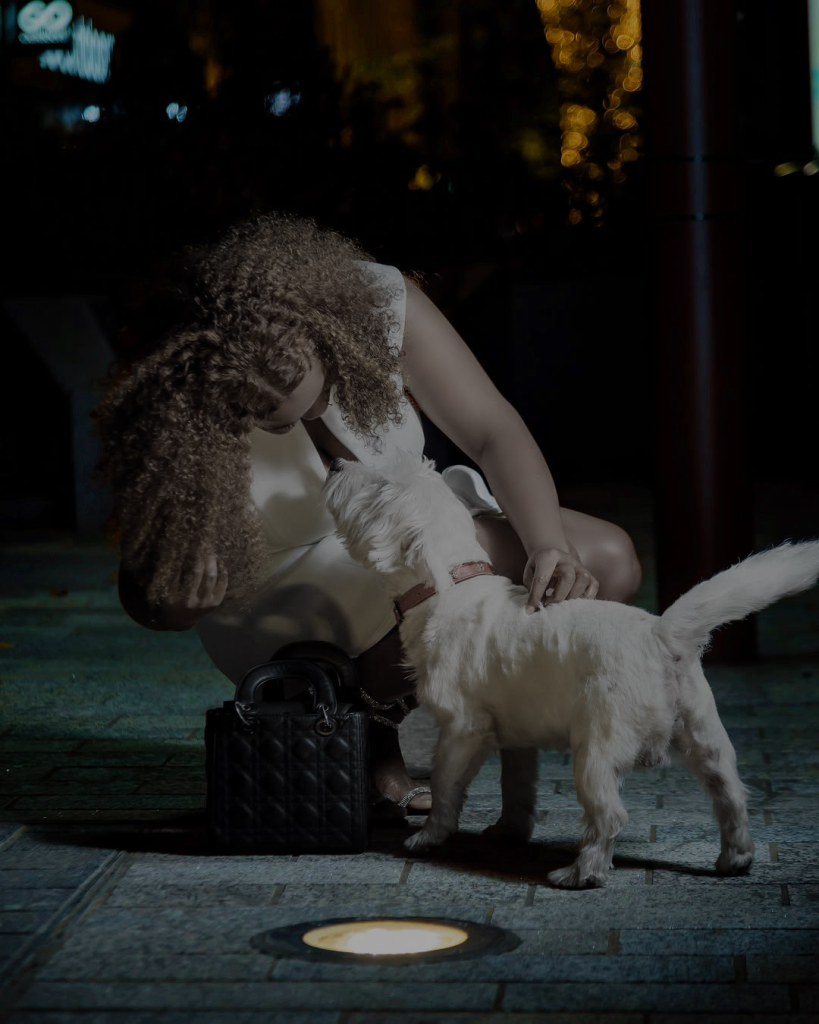
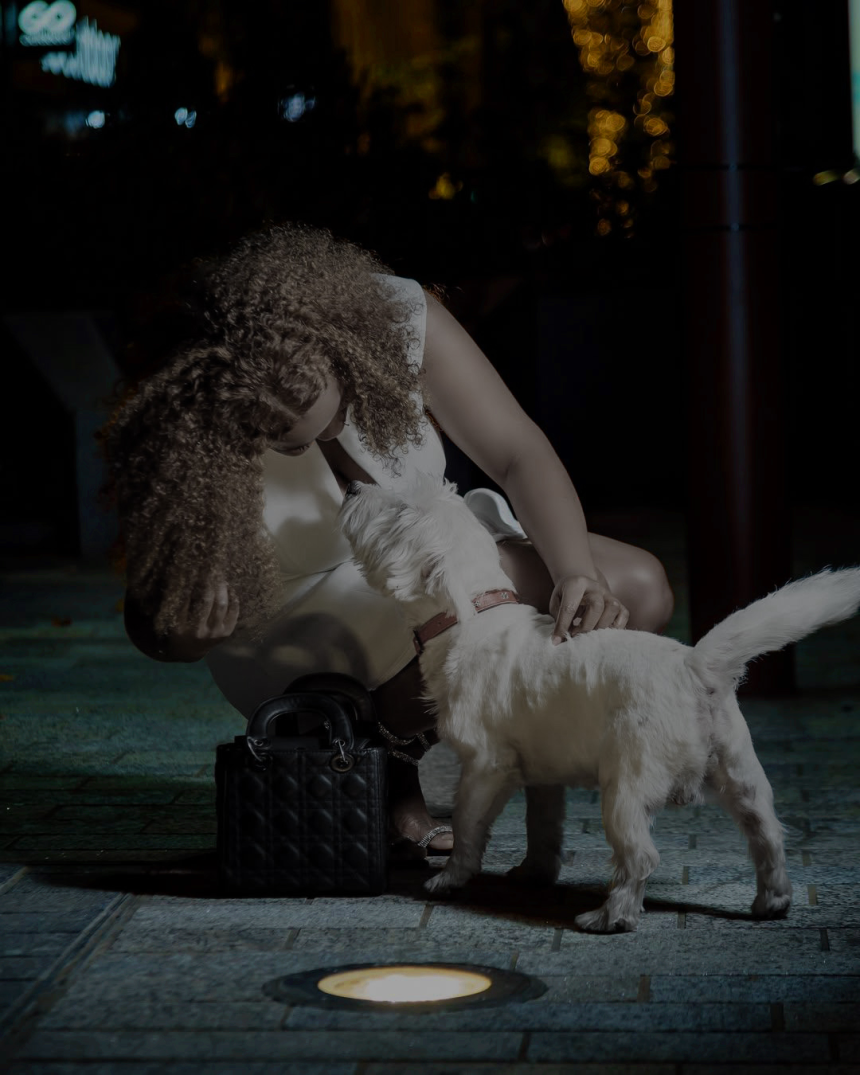
The subject of the photo is a woman in a street at night. She is bending down and caressing a furry dog. From her curly, flamboyant hair we could perhaps project that she is of mixed race. But this is uncertain. The hair could be a wig for all we know. What is concrete is that she is wearing white, which matches the dog’s thick fur. In the cluster of whiteness between the two animals, only the handbag beside her is black.
Symbol is heavy here in the use of white, which is saying peace and harmony between animals, specifically between humans and dogs. The street is quiet and blurred, visually silent, except for the woman and the dog. Beyond the symmetry of colours, there is something about the woman’s right hand which we cannot know. While her other hand pets the dog, the other hand is obscured by the action of light on her person and the shadow it throws to her side. The hand therefore becomes unremarkable because it appears like an amputated limb. “Streetlight Communion” is, for this reason, more or less about companionship and fellowship.
Abiodun has a way of using symbols, setting, and lighting to iterate human emotions, feelings, or a truth that exists in the universe.
Chimezie Chika is an art and culture journalist and writer of fiction and nonfiction, and a senior writer for Afrocritik. His works have appeared in, The Shallow Tales Review, The Republic, Lolwe, Iskanchi Mag, Isele Magazine, Efiko Magazine, Brittle Paper, and Afrocritik. He was a 2021 Fellow of the Ebedi International Writer’s Residency in Iseyin, Nigeria.
ALSO READ TOP STORIES FROM NIGERIAN TRIBUNE
WATCH TOP VIDEOS FROM NIGERIAN TRIBUNE TV
- Relationship Hangout: Public vs Private Proposals – Which Truly Wins in Love?
- “No” Is a Complete Sentence: Why You Should Stop Feeling Guilty
- Relationship Hangout: Friendship Talk 2025 – How to Be a Good Friend & Big Questions on Friendship
- Police Overpower Armed Robbers in Ibadan After Fierce Struggle


