
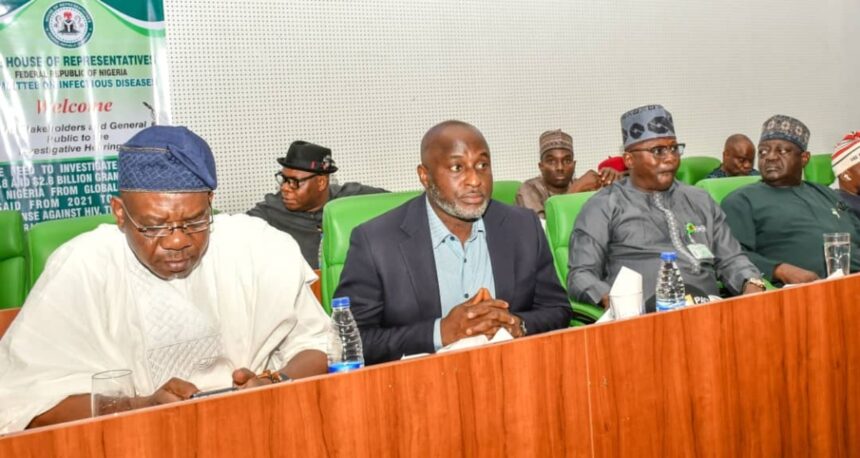
The House of Representatives on Monday invited operatives of Economic and Financial Crimes Commission (EFCC) and Independent Corrupt Practices and other Related Offences Commission (ICPC) to the ongoing investigation into over $1.8 billion and $2.8 billion grants received by Nigeria from Global Fund and USAID from 2021-2025 for the response against HIV/AIDS, Tuberculosis, Malaria and for supporting resilience and sustainable systems of health.
Addressing stakeholders who attended the investigative hearing held at the instance of House Committee on Infectious Diseases chaired by Hon. Amobi Ogah, the Speaker explained that the exercise was initiated in the spirit of transparency, accountability and governance.
According to him, some of the expected outcomes include: “a comprehensive evidence-based report detailing how the grants were received, how they were utilized and what impacts were achieved and where gaps or inefficiencies may exist, if any recommendations to strengthen governance financial management procurement monitoring and evaluation and accountability frameworks for health funding.
“The pathway to sustaining receiving health systems that can better prevent detect and respond to HIV, TB and malaria while protecting vulnerable populations and advancing universal health coverage. The investigation will adhere to establish studies house and international best practices for financial and pragmatic audits, while ensuring that all persons giving testimony will be afforded due process, fair treatment and protection where appropriate in accordance with the focus and intention of the House of Representatives.”
The Speaker, who was represented by the Majority Deputy Whip, Hon. Ayokunle Isiaka, further assured that the exercise will be open, fair and accessible to the public with channels for citizen participation and scrutiny, just as he urged all the stakeholders, implementers and public officers to provide accurate information and explanations regarding the management and utilisation of these resources under investigation.
Hon. Tajudeen, who assured that all discussions will be treated with utmost seriousness, confidentiality and any discrepancies or misplacements will be addressed promptly and judiciously, expressed optimism that the House will translate evidence into actionable reforms by ensuring that every dollar invested by our Partners in this country translates into healthier Nigerians, stronger health systems and a more resilient nation.
In his remarks, Chairman, House Committee on Infectious Diseases, Hon. Amobi Ogah assured all the Stakeholders including Development Partners and Network of people living with HIV, of transparent exercise.
“We also are glad that the EFCC and ICPC are here and we urge them to also dig deeper so that if there are any issues at the system, that we can collectively remedy them so that the domestic finances that we expect from this engagement will also be used properly,” he noted.
While noting that Nigeria continues to be battered by the ill effects of a greater burden of HIV, Tuberculosis, Malaria and other numerous infectious diseases, he observed that despite annual budgetary allocations and donor funds being mobilized for the response against these health challenges, “there is no reprieve in sight for the Nation, as Nigerians are ravaged daily by HIV, Tuberculosis and Malaria.
“It is within this context, that it becomes necessary to ascertain what has been done with the huge grants received by Nigeria from Global Fund and USAID for the response against these diseases from 2021 to date. We are aware that the grants received from international partners and donor agencies before now form 90% of the country’s intervention and investments in the response against these diseases.
“Henceforth, we cannot continue to receive grants and Aids that reduces us as mere spectators while the donor Countries spearhead the management and administration of those grants indirectly. We should call a spade by it’s name. Any grant or assistance being given to us without us managing such grant is unacceptable. If they would not give us such grants and assistance on our terms, then let them keep their grants.
“We must assert our capacity to take charge of our affairs, particularly in the response against HIV/AIDS, Tuberculosis and malaria. I also call on the Ministry of Health and Social Welfare and the Country Coordinating Mechanism to as a matter of urgency inform their principal recipients and implementing partners that National Assembly will demand for the submission of their implementation plans for approval before funds are released, going forward. The era of spending Nigeria’s money without approval and accountability is over.
“We are in the process of streamlining the coordination of the response against HIV, TB and Malaria with the amendment of the NACA establishment Bill to turn the agency to a multi-sector driven one with increased mandate to coordinate the response against HIV, TB and Malaria. The agency will be known as the National Agency for the Control of AIDS, Tuberculosis and Malaria, NACATAM when the bill is finally passed by the National Assembly.”
In his presentation, Minister of Health and Social Welfare, Dr. Ali Pate, who reaffirmedthe Federal Government’s commitment to transparency, accountability, responsibility and ownership, and health security for all Nigerians, commended the House for initiating the detailed hearing, at a time when the 20 years of global health financing that the country has enjoyed is coming to an end.
He however expressed optimism that the initiative will result into robust support through which federal and other State Governments will fill the gaps from the declining external financing that Nigeria had enjoyed for more than 20 years.
While noting that Nigeria bears a very disproportionate burden in terms of HIV, TB, malaria which collectively account for almost a third of deaths in the federation, he commended President Olusegun Obasanjo’s intervention between 1998 to 2001 that led to the establishment of the Global Fund funding mechanism for HIV, TB, and malaria in collaboration with the former US President George Bush.
“So Nigeria is infact a donor to the Global Fund and the purpose of the Global Fund is to attract, manage and dispose additional resources through new public-private partnership that will fast track sustainable and significant contribution to the reduction of infections, illnesses, and deaths. Since 2002, the fund partnership with the Nigerian government to strengthen health systems, save lives, and build resilience against future pandemics has evolved.”
“Also, in line with the principle of the fund, Nigeria adopted the 12-track grant implementation arrangement in the period 2024 to 2026. The Global Fund is a gap-filler mechanism. It is not originally intended to be the entirety of the country’s support, and it is not to replace government responsibilities to fund HIV, AIDS, TB, and malaria.
“The funding that is required, that has been required, if we look at 2024 as an example, 2025, and 2026, for HIV, with the burden that we have, the funding requirement was $577 million. The U.S. government contributed $396 million, the Global Fund $90 million.
“In 2024, for malaria, for TB, the funding need was $392 million, for example. The U.S. government put $22 million, the Global Fund $55 million and the government put $25 million. So, the goal for Nigeria is to fill the gap, which we have not been able to.
“The need for malaria, given the burden, was almost a billion, but $70 million was put forward by the U.S. government, $98 million by the World Bank and Islamic Development Bank. And the government was to step in with the balance. And the truth is that, despite those gaps, the funding that was received was for… In terms of the total grants for the period that we are reviewing now, we have seen a reduction, especially in this year in particular, and this hearing is perhaps an opportunity for us to come closer, and I take the speaker’s advice, for us to close the gap not only in financing but also in information so that the National Assembly can help us bridge those gaps.
“The implementation of the grants have made significant achievements, and they facilitated the provision of direct services to beneficiaries, strengthening health systems across 36 states of the Federation and preferred capital territory.
“1.74 million people on anti-retroviral therapy have been catapulted through these grants. Mother-to-child transmission reduced to less than 5 percent, and an annual HIV testing avoidance almost 1.46 million, 90 percent success rate in treatment of tuberculosis, with more than 400,000 lives saved through directly observed therapy expansion.
“We’ve treated more than 3,000 people for drug resistance and 16,000 HIV TB patients. The efforts have contributed to decline of malaria prevalence from 42 percent to 22 percent from 2010 to 2023, a 50 percent reduction in underlying mortality, which has contributed, given the burden of malaria.
“More than 30 million insecticide-treated nets distributed annually, and many more in terms of infrastructure and human resources, including the provision of oxygen-tanked information systems.
“In addition, the collective efforts of these grants, through the various implementing bodies, has resulted in nearly 1,000,000 deaths. This is a significant achievement. We have resulted in more than 1,500 motorbikes distributed to all the local governments, more than 50,000 Samsung Galaxy tablets to support service delivery, and five Hilux vehicles distributed.
“But there are challenges that are ahead of us. The funding gaps, which is the core issue. While the grants have come, I assure the National Assembly that as you investigate through the principal recipient and sub-recipients, you will find that there are some challenges.
“You will discover that, in some cases, 85-90 percent of the grants come to us in terms of commodities, procured from centrally procured ways that they just arrive as product, their in-kind contribution. But as we stand now, given the significant constraint in the external financing environment, with the Global Fund funding cycle, the uncertainties await.
“The today’s leaders who step forward today, around bilateral support from US government and others the domestic finance becomes very paramount and it has been far less than 15% target of the Abuja declaration which was done in 2001.
“The Ministry of Health budget has over around 5% as for the entirety of the Ministry of Health budget as a portion of the national budget. So we have been under-spending domestically and hence the inadvertent dependency on this external financing mechanisms. And with this hearing, we’re very encouraged that we will see Nigeria get closer to the target in terms of steady increase in domestic financing. The supply chain bottlenecks, because we’ve depended on imported commodities and in some quarter delays in the procurement of even our own commodities.
“There are gaps, especially this year in 2025. Which we’re trying to fill. But thankfully, the external funds have remained available. The data quality and reporting, I think, has improved considerably. And the governance and accountability measures and the oversight, not only at the federal level, but also at the state level and facility levels, I think has been very robust,” he noted.
The Minister disclosed that 95% of the funds that have been disbursed through the Global Fund and the US government have been accounted for through verified reports which I believe have been shared with you and can be discussed in detail with you. The fraud prevention, we have zero tolerance policy on fraud and any anomalies that are promptly flagged for investigation and recovery, including whistleblowers.
“The sustainability angle is also paramount in our mind with our transition plan to integrate the Global Fund and US government supported programs into our national programmes so that we exit from the dependency and to facilitate local manufacturing of commodities so that much of these commodities will not be brought from abroad but that we produce them locally.”
In the bid to sustain the momentum, Dr. Pate advocated for increasing domestic investments through the appropriation process with a view to strengthen the collaboration between federal, state and non-state actors, including State Assemblies to look at what is going on in their respective seats and to continue to add your voices through Committee engagement.
WATCH TOP VIDEOS FROM NIGERIAN TRIBUNE TV
- Relationship Hangout: Public vs Private Proposals – Which Truly Wins in Love?
- “No” Is a Complete Sentence: Why You Should Stop Feeling Guilty
- Relationship Hangout: Friendship Talk 2025 – How to Be a Good Friend & Big Questions on Friendship
- Police Overpower Armed Robbers in Ibadan After Fierce Struggle


