
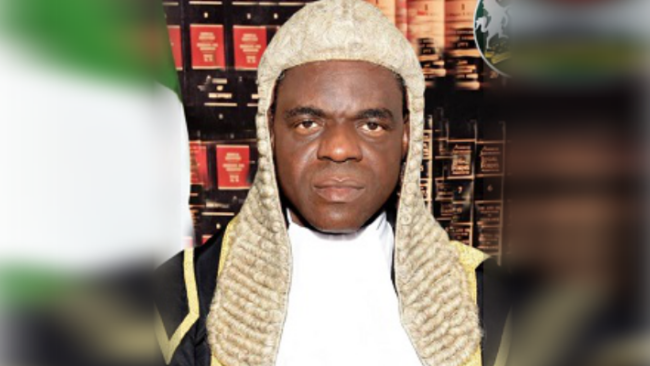
A reported invitation extended by the Code of Conduct Bureau (CCB) to the Chief Judge of the Federal High Court, Justice John Tsoho, over alleged non-declaration of assets has triggered fresh legal debate over which institution is constitutionally empowered to investigate and discipline serving judicial officers in Nigeria.
This is because the development has drawn reactions from legal practitioners, with some insisting that while the CCB may scrutinise asset declaration forms, the National Judicial Council (NJC) remains the only constitutionally recognised body with authority to discipline or sanction a sitting judge.
Speaking in an exclusive interview with the Nigerian Tribune on Thursday, human rights lawyer Dr Yemi Omodele argued that the NJC has the exclusive constitutional mandate to oversee the appointment, promotion, control, and discipline of judicial officers.
According to him, any attempt by another body to directly investigate or discipline a serving judge outside that framework may amount to an overreach.
Omodele, however, distinguished between the administrative and disciplinary jurisdiction of the NJC and the statutory responsibility of the CCB to monitor and review asset declaration forms submitted by public officers, including judges.
According to him, while judicial officers are required by law to complete and submit Code of Conduct forms, that obligation does not automatically give the CCB supervisory control over the judiciary.
The lawyer said the real issue lies in what he described as a lacuna in the law regarding how alleged discrepancies in a serving judge’s asset declaration should be handled.
According to him, the CCB is empowered to monitor compliance with asset declaration requirements, but the NJC retains disciplinary authority over serving judges.
That overlap, he said, creates uncertainty where a judicial officer is alleged to have omitted or failed to disclose certain assets or accounts.
Omodele suggested that the existing legal framework may require legislative clarification to resolve the interface between both institutions and prevent recurring disputes over jurisdiction.
He said that unless the law is amended or clarified, the uncertainty over who should take the first procedural step in such cases may persist.
ALSO READ: Top 10 Eid Mubarak messages to send to friends, family
Another rights lawyer, Ige Asemudara, also faulted any direct move by the CCB against a serving judicial officer without first routing the matter through the NJC.
Asemudara maintained that the NJC is the constitutionally recognised body responsible for disciplining judicial officers and that, until a judge is first subjected to the council’s disciplinary process, no external agency should take coercive action that could amount to disciplinary interference.
He said the proper course, if the CCB detects any infraction in a judge’s asset declaration, would be to formally petition the NJC, outlining the alleged breaches and allowing the council to consider the petition on its merits.
According to him, once the NJC has exercised its disciplinary powers in line with the law, other institutions may then proceed as permitted by law.
Asemudara also referenced the well-known judicial discipline precedent in FRN v. Justice Nganjiwa, a case frequently cited in debates over whether serving judges can be directly investigated or prosecuted for alleged misconduct arising from their official conduct before the NJC first acts.
He said the principle from the case reinforces the view that judicial officers enjoy a procedural shield requiring prior recourse to the NJC before criminal or quasi-disciplinary action can be taken in matters connected to judicial office.
The lawyer stressed that his position should not be interpreted as a defence of any alleged wrongdoing, but rather as a call for strict compliance with constitutional procedure and the rule of law.
WATCH TOP VIDEOS FROM NIGERIAN TRIBUNE TV
- Relationship Hangout: Public vs Private Proposals – Which Truly Wins in Love?
- “No” Is a Complete Sentence: Why You Should Stop Feeling Guilty
- Relationship Hangout: Friendship Talk 2025 – How to Be a Good Friend & Big Questions on Friendship
- Police Overpower Armed Robbers in Ibadan After Fierce Struggle


