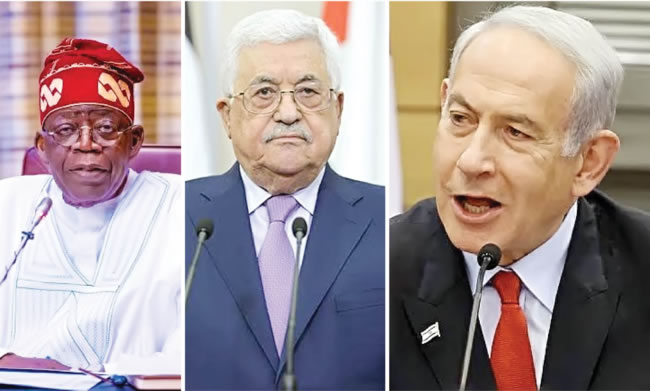
The swift and coordinated cross-border attacks launched by Hamas fighters from the Gaza Strip into Israel last Saturday, October 7, has triggered the ongoing full-scale war between Israel and Palestine. In a swift reaction, the Nigerian government issued a diplomatic statement that assumes a neutral position, called for cessation of hostilities and respect for international law by both sides to prevent further needless humanitarian catastrophe. The attacks which coincided with the 50th anniversary of the October 1973 Arab-Israeli War or the Yom Kippur War caught Israel by surprise perhaps because of the failure of intelligence or over-estimation of Israel’s capacity to defend itself. If Israel was caught pants down, so was the US, its most important strategic ally and supporter whose Secretary of State, Antony Blinken, only a week or so ago gloated that he, unlike his predecessors who were kept preoccupied by myriad crises in the region the Middle East, had nothing to worry about because the region had been quietened. As if to bust his bubble and hubris, Hamas launched unprecedented attacks from land and air by para-gliders while simultaneously firing thousands of rockets on Israeli towns and settlements. As of today, thousands of men, women and children, both combatants and innocents on both sides, have been killed, many thousands more wounded, residential buildings and infrastructure in Gaza levelled by missile bombardments and hundreds of thousands displaced.
Opinions around the world, especially from the governments of major Western nations i.e., the US and its European allies, which have traditionally been in support of Israel have been so nauseatingly skewed and one-sided that only the Palestinians are brought up for condemnation for launching what they term “unprovoked and brutal terrorist attacks.” In a joint statement issued by the leaders of France, Germany, Italy, UK and US, they not only declared their “steadfast and united support to the State of Israel, and … unequivocal condemnation of Hamas and its appalling terrorism” but also asserted “that the terrorist actions of Hamas has no justification, no legitimacy, and must be universally condemned.” There was not a word on any atrocities by Israel. It is usually this kind of blind, callous, insensitive and one-sided support for Israel against the Palestinians by those nations that regard themselves as the guardians of the so-called rules-based international order that normally incense and provoke fanatical supporters of Palestine into fury and action, making peace a scarce commodity in that region.
Here in Nigeria, the Federal Government has adopted a wise and moderate diplomatic stance, calling for immediate cessation of hostilities on both sides to allow for peaceful resolution. The statement signed by the Minister of Foreign Affairs, after noting that violence only brings pain and suffering to civilian populations, “calls on both sides to exercise restraint, prioritize the safety of civilians and give room for humanitarian considerations. We are therefore calling for peaceful resolution of the conflict through dialogue.” Though the government has taken this noble stand on the side of peace for all concerned in this violent hostilities, it is important to realize that Nigerian peoples have always held divergent views regarding Israelis who are Jews and the Arabs who are Muslims, ranging from the objective, to the analytical and to the downright emotional, and condemnatory of one side or the other. Generally, Muslims have historically taken positions that sided with the Arabs against Israel, some so viscerally hateful of Jews and fanatically convinced that Israel has no right whatsoever to exist as a state. On another extreme are Christians who side with Israel because they believe that the Jews are the ‘rightful’ owners of the land of Palestine that God had given them, as per the Bible. Both positions, as I said earlier, are not based on any objective analysis but purely on religious conviction. But there are also portions of Igbo people who claim that they are actual descendants of the Jews, calling themselves ‘Israel’s Lost tribe’, claiming, rightly or wrongly, that Israel’s support and assistance given to Biafra during the Nigerian civil war was predicated on their common ancestry.
That differential perceptions and opinions on the relationship between the state of Israel and its Arab neighbours have been known to influence the positions of successive Nigerian governments on the Middle East since independence. For context, a little trip down memory lane is required.
Immediately after independence, several countries wanted diplomatic relations with Nigeria which they regarded as the pre-eminent African country, and Israel, not surprisingly, was one of them. But Nigeria-Israel bilateral relations was fraught because of a North-South divide over recognition of Israel. The predominantly Muslim North under the control of Northern Peoples’ Congress (NPC) stiffly opposed any relationship with Israel, while both Western and Eastern Regions in the South were in favour, because they had enjoyed beneficial cooperative relations with Israel in the areas of agriculture, technology, education and infrastructure from the 1950s with scores of Israeli experts and construction firms like Solel Boneh operating in Southern Nigeria. Thus compelled by Force Majeure to permit establishing diplomatic relations to avoid alienating the wishes of the entire South but especially the NCNC coalition partner in government, the Israeli ambassador in Lagos was quietly advised never to visit Northern Nigeria out of respect for the sensibilities of the largely Muslim North. This was what I had described elsewhere as the Nigerian government of Prime Minister Alhaji Sir Abubakar Tafawa Balewa walking a diplomatic tightrope.
But this bilateral relations suffered a break in 1973. Even though Nigeria had no particular grudge against Israel but it had to comply with the resolution of the then Organization of African Unity (OAU) that all African countries should sever diplomatic relations with Israel. This resolution came at the request of Egypt and other Arab member states in the aftermath of the Arab-Israeli War of that year, known in Israel as the Yom Kippur War. And thus ended the mutually beneficial bilateral relations, perhaps to the delight of those who never wanted it in the first place. But if breaking relations was easy, reestablishing same years later was much harder due largely to domestic politics and the sharp fault-lines that had subsisted on the issue since independence, even long after Egypt, at whose behest the decision to break relations was taken in the first place, had made peace and normalized relations with Israel via the Camp David Accords of September 1978. It probably would have been hemlock for President Shehu Shagari to do it, and neither was General Muhammadu Buhari favourably disposed to it.
Lest we forget, it was actually during Buhari’s military regime that a suspension was slapped on the Ooni of Ife, Oba Okunade Sijuwade and Emir of Kano, Alhaji Ado Bayero, for visiting Israel in August 1984. This private but high profile visit of the two revered traditional rulers became a diplomatic embarrassment for the Federal Government when it was widely publicized in both Israeli and international news media that they were received in audience by the then Israeli President, Chiam Herzog, Prime Minister Yitzhak Rabin and other senior Israeli government officials, at a time Nigeria was under intense international pressures to reopen bilateral relations with Israel. It would not be until September 1992 that relationship would be restored. Today, both countries enjoy cordial relations and maintain resident ambassadors in each other’s capital.
Nigeria’s current position of not taking sides in the ongoing war, which is also in tandem with that of the African Union, is a commendable one which would not put Nigeria’s interests in jeopardy going forward, and neither would it affect the country’s standing as an OPEC member. Nigerian governments, since the restoration of diplomatic relations in 1992, have hardly been under any untoward external pressures to take sides in contemporary Palestinian-Israeli conflicts. It is only if the war escalates with the involvement of regional neighbours in the Middle East that it can affect global oil prices should the Arabs decide to punish the West as they did back in 1973, an act that quadrupled global oil prices from which Nigeria profited immensely. But any major spike in global oil prices is bound to adversely affect the Nigerian economy which for now relies on imported petroleum products.
While there is no imminent threats to Nigeria’s national interest, the situation must nonetheless be carefully monitored to prevent any harms being done to Nigerians visiting (pilgrims) or resident in the region. Readiness to evacuate them is important, for no one has a crystal ball to tell how far this current armed hostilities would go. Nigeria must stay the course, refuse to take sides but keep its insistence on peaceful resolution to stop the needless humanitarian catastrophe; it thus must avoid being dragged into any one-sided resolutions that might be raised at the UN or other such platforms.
At home, government needs to ensure it disallows anyone or group that might wish to exploit the ongoing war and the incendiary rhetoric coming both from Israeli Prime Minister and the Western leaders to cause political choas in the country.
- Fawole teaches International Relations at the Obafemi Awolowo University, Ile-Ife.
READ ALSO FROM NIGERIAN TRIBUNE
WATCH TOP VIDEOS FROM NIGERIAN TRIBUNE TV
- Relationship Hangout: Public vs Private Proposals – Which Truly Wins in Love?
- “No” Is a Complete Sentence: Why You Should Stop Feeling Guilty
- Relationship Hangout: Friendship Talk 2025 – How to Be a Good Friend & Big Questions on Friendship
- Police Overpower Armed Robbers in Ibadan After Fierce Struggle