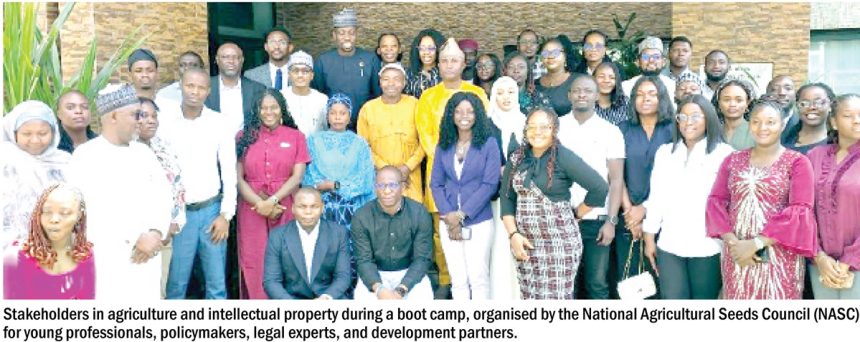
NIGERIA’S quest for sustainable food security received a major boost on Monday, as stakeholders in agriculture and intellectual property converged on Abuja for the Plant Variety Protection (PVP) and Intellectual Property Boot Camp 2026, with focus on how legal protection of plant innovations can safeguard the nation’s food future.
The boot camp, organised by the National Agricultural Seeds Council (NASC), brought together young professionals, policymakers, legal experts, and development partners to deepen the implementation of the Plant Variety Protection (PVP) Act 2021 and strengthen Nigeria’s agricultural innovation ecosystem.
Declaring the programme open, NASC Director-General, Fatuhu Muhammed, said the initiative was more than a technical training exercise, describing it as a strategic intervention to reinforce food security through innovation.
He explained that improved crop varieties, characterised by higher yields, resistance to pests and diseases, and tolerance to climate stress, are the backbone of modern food systems. However, he noted that such innovations require legal protection to thrive.
“The passage of the PVP Act was historic, but legislation alone does not deliver impact. Impact comes from competent administrators, skilled breeders, and informed professionals who understand both national obligations and international standards,” he said.
Muhammed noted that Nigeria’s PVP framework aligns with the standards of the International Union for the Protection of New Varieties of Plants (UPOV 1991 Act), positioning the country to attract investment in plant breeding and seed development.
READ ALSO: Buhari expresses satisfaction with Nigeria-US relations
He stressed that food security cannot be achieved without sustained agricultural research and innovation. According to him, when breeders are confident their intellectual efforts are protected, they are more likely to invest in developing climate-smart and nutrient-dense varieties capable of addressing hunger and malnutrition.
In her goodwill message, Chief Registrar of Patents and Designs, Jane Igwe, reinforced the link between plant variety protection and national food stability.
She described plant breeders’ rights as the legal mechanism that transforms years of scientific research into protected assets, encouraging continued innovation in seed systems.
“In a country where food systems are critical to national stability and economic growth, protecting plant varieties is not a luxury, it is a necessity,” she said.
Igwe explained that improved seeds do not emerge by chance but are the product of multiple breeding cycles, field trials, and significant financial investment. Without protection, she warned, innovation becomes vulnerable, discouraging long-term research essential for strengthening food systems.
She added that plant variety protection attracts agricultural investment, enhances productivity, supports climate-resilient crops, and facilitates global trade, all of which are critical components of food security.
A representative of the Registrar of Trademarks also highlighted the complementary role of intellectual property in agriculture, noting that trademarks help breeders build trust and brand value in the marketplace, ensuring that improved varieties reach farmers and consumers efficiently.
Stakeholders at the event emphasized that the Boot Camp is designed to equip 30 selected young professionals, chosen from over 600 applicants, with the technical and legal expertise needed to manage breeders’ rights, conduct DUS examinations, enforce compliance, and promote institutional coordination.
By strengthening the human capacity behind Nigeria’s plant variety protection system, organisers said the Boot Camp aims to build a resilient, transparent, and globally aligned framework that supports agricultural productivity and long-term food security.
As climate change, population growth, and economic pressures continue to strain Nigeria’s food systems, participants agreed that protecting innovation in plant breeding is central to ensuring stable food supplies, farmer livelihoods, and national development.
The consensus at the Abuja gathering was clear: safeguarding plant varieties is not just about intellectual property, it is about securing Nigeria’s food future.
WATCH TOP VIDEOS FROM NIGERIAN TRIBUNE TV
- Relationship Hangout: Public vs Private Proposals – Which Truly Wins in Love?
- “No” Is a Complete Sentence: Why You Should Stop Feeling Guilty
- Relationship Hangout: Friendship Talk 2025 – How to Be a Good Friend & Big Questions on Friendship
- Police Overpower Armed Robbers in Ibadan After Fierce Struggle