
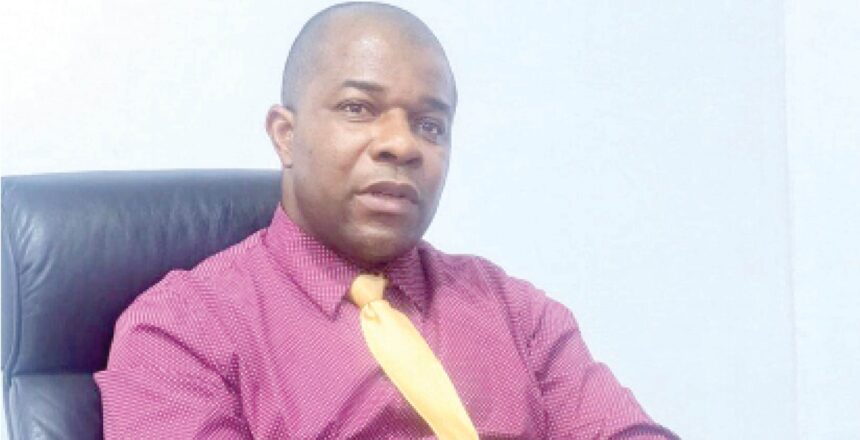
Registrar/CEO of the Council for the Regulation of Freight Forwarding in Nigeria (CRFFN), Mr Kingsley Igwe, in this interview with newsmen, speaks on key issues affecting the Council and the freight forwarding sector at large. TOLA ADENUBI brings the excerpts:
Let’s begin with an update on the POF issue. Any update on the legal and court issues surrounding its collection?
There is no much update on that. The court judgement has been appealed. It is only when the court calls us for a sitting. Right now, it’s still at that level of the appeal. So there might not be anything much for now. The only update is that the court has not fixed a date for the hearing.
There have been concerns about the reconstitution of the CRFFN Governing Council. What really is happening?
According to the Nigerian Constitution, the board should be constituted by people knowledgeable about that profession or the sector. They can be from public or private service. CRFFN is the only agency in Nigeria that has a 32-member board. Tell me any other agency that has a similar board? None. The highest I know is about 12—maybe NPA. As big as these agencies are, their boards are as small as 12 members. They were duly selected from among industry players. Only then are there eight. The political representatives is just about four or six and the other ones are purely on professional qualifications. That is how it should be. CRFFN’s board aggregates people from geopolitical zones, political appointees, individuals of interest, and elected industry members. That is why we have 32. Look at the implication in terms of cost.
CRFFN is the least funded agency, yet we have the most representation from the government compared to our sister agencies. Not less than 60 percent of our annual overhead goes to the operation of the board. If our annual overhead is N300 million naira, 60 percent of that is used to ensure the board operates. Is that economically effective? No. It means that the overhead of the agency is threatened. Because you have to conduct training from overhead, you have to ensure that you engage in travels for important participation in important events and the rest of it; both overseas and local. It is from the overhead. You also have to ensure staff welfare and sometimes incentives to boost staff morale are from overhead. We rarely have that. So these are some of the challenges. It is not because I am saying it. This is also the challenge that even the government wants to solve. The presidency knows about this. The ministry knows about this. They want to solve it. They have seen it is practically wrong for CRFFN to have that number of governing council. I am not the one saying don’t constitute the board. I want to be very clear on this. I am not the one saying it. It is what is practical. If that board had been, let’s say, within practical range. 10, 11, 12. That board would have been constituted a long time ago. This is because it is a tool for all the manipulations. I don’t know when the decision will be taken. That is why I think they are still permutating.
I don’t know anything about it. I am not involved. I don’t know what discussion is being had. Tomorrow, they can come up and call me and say this is what they have done. I will not say no. Whatever comes from the higher authority either from the ministry, National Assembly or from the Presidency, I am ready to comply. I, single-handedly, cannot stop the board. Whoever said that doesn’t know how the government operates. He is only talking from sentimental view based on events that have happened in CRFFN. No Registrar will say the board should not be constituted. Who does that? Nobody does that. The MD of NPA cannot say his board should not be constituted. No, he is not the decision maker until the President, the FEC or the national assembly. That is only when we can. So anyone saying he is the Registrar is only being ignorant of hierarchy. It is not me. So that is that about the board.
Why have you not been able to penetrate the aviation sector for POF collection?
Oh yes. We already have a working understanding with FAAN. That was what gave us the advantage to conduct our training there the last time, which we are repeating in Abuja and other parts. The only reason we haven’t done much repetition of that training is because of funds—primarily. And secondly, many new initiatives are coming up such as the National Single Window, digitization, I need to give them physical attention to avoid gaps. I really want to be there physically and ensure the right process; the right things are penned down and the right structure is set. If I am not there, a lot of gaps will be created. Like we have and MoU with CBi-MACN. At least from there, you can see a bit of what I am talking about. These things did not start today. It started since early this year and I have been following through every bit of the process to ensure that we are able to think far and wide on how this can benefit the industry. I have seen the benefit of this in the freight forwarders industry. That is why I encourage it. Very soon we are going to start trainings on the National Single Window. I am an active member of the National Single Window structuring process. Most of the errors I have to correct and they solidify. These are practical corrections. There are things that are very simple. And I have to follow them.
What would you consider your key achievements in one year?
One of the things I told you was my interest in massive training, introducing standards, and digitising processes. We have achieved this to an extent. The design stage is almost completed. The next phase is to launch some of these platforms. That will standardise the process. That is a whole package, including what we’ve done today. It’s an integral part of that. Integrated. This will bring some level of SOP. It’s not something you need to circumvent. I don’t need to downplay too many enforcements to see whether you follow the process. It’s you and the system. If you try to use the system and the system disallows you from manipulating it. You deal with it. So we are bringing standards. The freight forwarding sector is like an informal sector with many informal practices everywhere. This is one of the tools we are using to formalise the system, including National Single Window. How much you’re charging for whatever you’re charging will be standardised. It’s not just anybody just wake up and chooses what to charge. Everybody will have to know this. Everybody will have to know the procedures. Like everybody knows what pure water is. It’s going to be successful but it’s going to take time. Standardisation and digitisation are 60 percent achieved.
On training, we have not been able to conduct as many trainings as we wanted. Why? Because some of the instruments that will help us to conduct these trainings are also being developed. So, we are coming from a region where there is nothing and we are creating something. This is not to talk down on what the previous administrations have done. Let me use the word we are going from manual to digital. Manual has really not helped. Even the manual, you can’t make reference to any record. So, these were the challenges. But we have been able to aggregate information and develop processes and systems that can help us to now chart the way forward. We have achieved that.
READ ALSO: Aside POF, CRFFN targets new avenues for revenue generation
WATCH TOP VIDEOS FROM NIGERIAN TRIBUNE TV
- Relationship Hangout: Public vs Private Proposals – Which Truly Wins in Love?
- “No” Is a Complete Sentence: Why You Should Stop Feeling Guilty
- Relationship Hangout: Friendship Talk 2025 – How to Be a Good Friend & Big Questions on Friendship
- Police Overpower Armed Robbers in Ibadan After Fierce Struggle


