
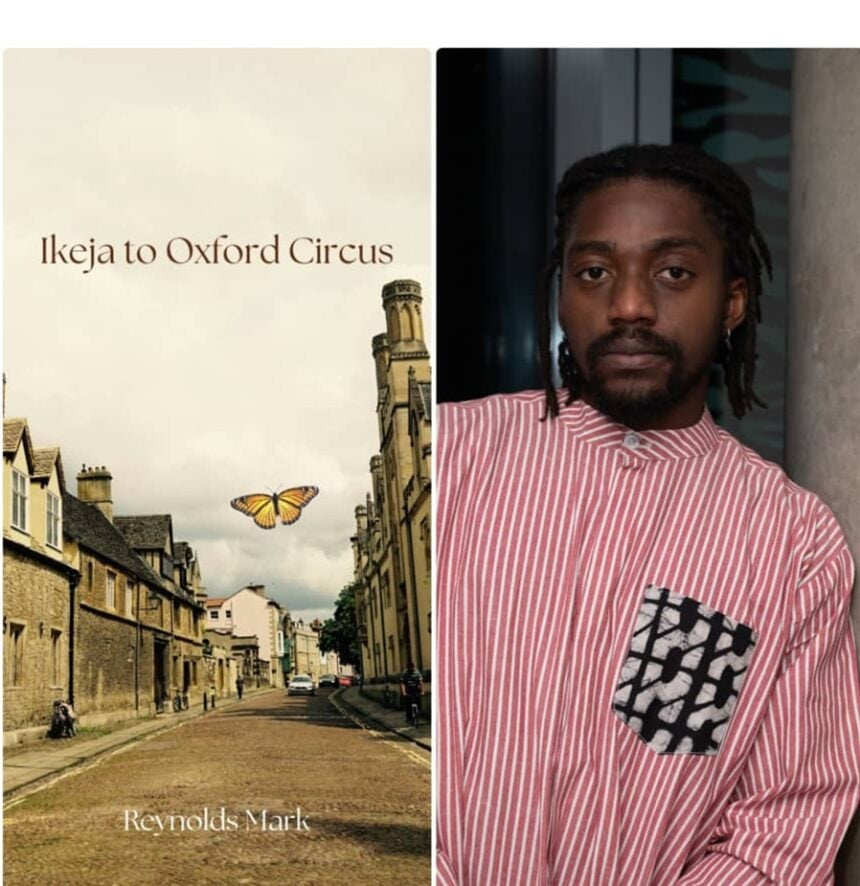
Migration experiences continue to throb across global spaces, offering continuing contexts of creative explorations and discourse paradigms. However, it is a once-in-a-while, unique endeavour to effectively capture the context of a literal yet metaphorical journey of movement across borders. And that is what Reynolds Mark’s Ikeja to Oxford Circus has interestingly achieved.
Ikeja to Oxford Circus, an anthology of poems, takes the reader on a figurative and all-too-real journey of exploration, from Ikeja in Lagos, Nigeria, to the Oxford Circus in London. The title of the poem is significant, as it brings renewed immediacy to the subject matter highlighted in the creative work. The poems in the collection depict experiences of migration, disillusionment, cultural reorientation, survival, love, and resilience. The poet-persona engages in a renegotiation of the context of home, as there is a venture across roads and seas towards a new geography, which comes with fresh encounters, that in some cases, do not appear to be so different from the perspectives recorded from the take-off place of belonging. The anthology explores the notions of alienation and memory in the effort to interrogate the conditions surrounding identity and cultural transformation.
Identity is a major theme that runs through the poems. The poet makes deliberate efforts to establish a sense of identity, especially with the intricacies that come with moving to a new environment and encountering new cultures and viewpoints. For instance, in the poem, “Ikeja to Oxford Circus”, the lines “I came with two boxes / one for dreams, one for sweaters… / …Still, I carried Lagos in my laughter / and Nigeria in the rhythm of my breath”, engage an intentional outlook towards the circumstances that are linked to identity crisis. The poet adopts a dual-citizenship role, represented in the acceptance that there needs to be a sense of cultural reorientation, yet holding tightly onto the rhythm of home.
Migration is closely associated with the context of identity, in that while movement takes place through physical shift from one place to another, there is also a shift in the sense of self. The journey from Lagos to London does not just take place in the change of settings, but also in cultural and psychological spaces. The poems explore use of literary techniques to drive captured tensions, with the use of denotative and connotative terms to portray settings in literal and metaphorical contexts, bringing to the fore the significance of the familiar and the far-flung.
Memory is significantly engaged in the poems, as the poet explores the dividing, as well as uniting, experiences that diminish and create memory. For instance, in the poem, “From Harmattan to Winter”, the concept of memory is presented through literary contradictions and alignments, as seen in the lines, “Dust becomes snow, dissolving / into a stream of memory / Memories of brown dust and / Memories of white snow, borders shrink…”. The concerns highlighted in the poems on memory foreground the navigation of new environments, as the poet-persona evaluates unfamiliar sights and sounds and tries to establish a sense of connection with what is strange, juxtaposed with the recognisable. The poems ruminate on the differing sense of community, taking what the poet-persona remembers about home, and trying to find a fit for what now has to be confronted, as this is a new sense of belonging where the need to forge fresh relationships has to be established.
In terms of structure and poetic style, the poet persona weaves between the lyrical and the reflective, between the domestic and the global, between the spatial and the expressive. Imagery is as vivid as it is provocative, establishing a bubbling expanse of symbolic references that constructively interrogate the voyage motif.
In such a timely creative, poetic potpourri of rustic-yet-urban experimentation expanse as depicted in Ikeja to Oxford Circus, migration establishes hybridity, identity accentuates luminosity, and memory highlights re-definition of self and community.
Reynolds Mezue Mark has proven to be one of the next generation of young writers, adding their voices to engage the subject of home, memory, nostalgia, migration and the peculiarity of the struggles of ethnic minority people and people of African Heritage. His comparative literary offering, Ikeja to Oxford Circus, engages the binaries of two worlds which has both birthed and shaped Reynolds’ poetry. I look forward to what more this young man would be offering to the poetic and literary collective of the United Kingdom and his home country, Nigeria. Reynolds Mezue Mark is a poet to look out for.
Chinyere Chukwudi-Okeh is a UK-based Scholar-Writer, Author, Poet and Critic
ALSO READ TOP STORIES FROM NIGERIAN TRIBUNE
WATCH TOP VIDEOS FROM NIGERIAN TRIBUNE TV
- Relationship Hangout: Public vs Private Proposals – Which Truly Wins in Love?
- “No” Is a Complete Sentence: Why You Should Stop Feeling Guilty
- Relationship Hangout: Friendship Talk 2025 – How to Be a Good Friend & Big Questions on Friendship
- Police Overpower Armed Robbers in Ibadan After Fierce Struggle


