
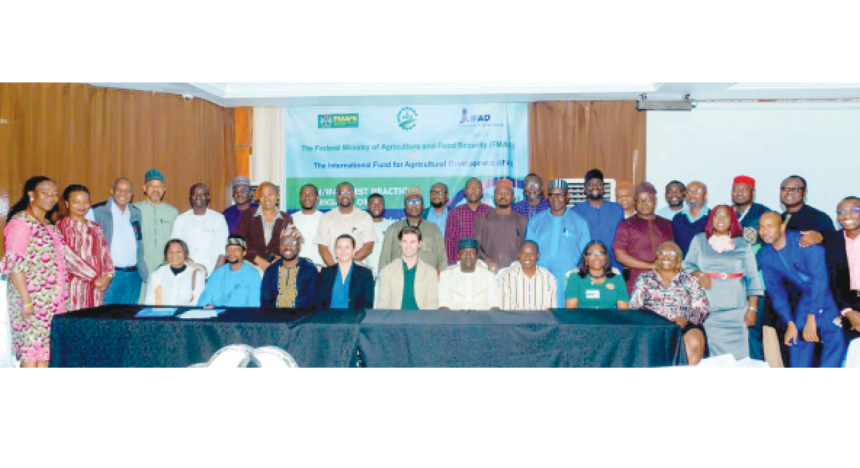
Policymakers, development partners, private sector leaders, and farmer representatives convened in Abuja for the FGN/IFAD Best Practice workshop on Public-Private Partnerships (PPP) for Climate Information Services, alongside consultations for the ambitious Climate-Smart Agribusiness Partnership for Resilience (CSAPR) Project.
Convened by the Federal Government of Nigeria in collaboration with the International Fund for Agricultural Development (IFAD), the five-day event sought to discuss how Nigeria can safeguard its food systems in the face of climate change while opening new doors for innovation and investment.
Agriculture remains the backbone of Nigeria’s economy, employing nearly 70 per cent of the workforce and contributing roughly a quarter of national GDP. Yet the sector is under siege. Erratic rainfall, prolonged droughts, and recurring floods are steadily undermining yields, threatening food security, and pushing millions deeper into poverty.
“Climate change is not a distant threat, it is a daily reality. Farmers cannot adapt without timely and reliable information on when to plant, when to harvest, or how to prepare for extreme weather. Agribusinesses cannot scale sustainably without reliable data, early warning systems, and risk management instruments”, Mrs. Dede Ekoue, IFAD Country Director for Nigeria, said in her opening remarks.
Experts agreed that Climate Information Services (CIS), ranging from seasonal forecasts to real-time advisories, can transform agricultural productivity. Globally, every dollar invested in early warning systems yields at least ten dollars in benefits, according to development economists. Even a 24-hour weather warning can reduce potential damages by up to 30 percent.
For Nigeria, the stakes are even higher. Projections suggested that agricultural productivity could decline by 10–25 per cent by 2080 without major adaptation measures. In some northern regions, staple crops like maize, millet, and wheat could see yield reductions of up to 50 per cent.
Recently, NiMet launched its Enhancing National Climate Services (ENACTS) Maproom, a digital platform providing real-time weather forecasts, historical climate data, and tailored advisories for farmers and agribusinesses.
“This initiative is more than just about technology; it is an investment in preparedness. It is about a future where informed choices lead to sustainable progress. With the Maproom, we are enabling smallholder farmers to make better decisions that protect their livelihoods and strengthen resilience”, said Prof. Charles Anosike, Director-General of NiMet.
But NiMet alone cannot carry the weight of this transformation. As Anosike emphasized, sustainable Digital Climate Advisory Services (DCAS) will only be possible if the private sector steps in, through fintech platforms, insurance companies, agri-tech startups, and commercial banks, bringing innovation, financing, and market reach.
For too long, climate-smart interventions in Nigeria have been confined to pilot projects, innovative but limited in scope. Public-Private Partnerships (PPPs) are seen as the key to breaking this cycle, helping to embed CIS into everyday agribusiness operations, financial services, and market transactions.
The proposed Climate-Smart Agribusiness Partnership for Resilience (CSAPR) Project embodies this shift. Anchored within Nigeria’s Special Agro-Industrial Processing Zones (SAPZ), the initiative seeks to integrate climate information into value chains, ensuring that input suppliers, aggregators, financial institutions, and processors can all benefit from climate data while delivering tailored products to smallholder farmers.
“This is a bold step forward. It is about turning climate challenges into opportunities for economic growth, youth employment, and sustainable development”, Ekoue stressed.
For the Federal Ministry of Agriculture and Food Security, which co-hosted the workshop, CSAPR represents both a challenge and an opportunity.
“Today marks a significant milestone in our collective efforts to safeguard Nigeria’s food systems. By harnessing PPPs, scaling up climate information services, and embedding climate-smart practices within our agro-industrial hubs, we can empower our farmers, strengthen our food systems, and drive sustainable economic growth”, said Mr. Ibrahim Tanimu, Director of Planning and Policy Coordination at the Ministry.
The Abuja workshop did not occur in isolation. It was framed against a broader backdrop of international and continental commitments.
Only weeks earlier, at the UN Food Systems Summit +4 in Addis Ababa, African leaders reaffirmed that food systems transformation must prioritize resilience, inclusivity, and sustainability. The CAADP Kampala Declaration underscored the importance of mobilizing investments for innovation and ensuring women and youth remain at the center of agricultural transformation.
At home, Nigeria has outlined its Food Systems Transformation Pathways and the National Agricultural Technology and Innovation Policy (NATIP, 2022–2027), both of which emphasize climate-smart agriculture, digital innovations, and private sector engagement.
The CSAPR project, stakeholders noted, neatly aligns with these frameworks while building on IFAD’s existing investments in the Value Chain Development Programme (VCDP), Livelihood Improvement Family Enterprises in the Niger Delta (LIFE-ND), and the Special Agro-Industrial Processing Zones (SAPZ).
Despite producing the bulk of the country’s food, smallholders remain excluded from structured value chains. Their access to irrigation, markets, credit, and reliable weather information is limited. Many depend on traditional knowledge that is no longer sufficient to cope with today’s volatile climate.
Through CSAPR, farmers could receive text alerts before a heavy rainfall, guiding them to delay planting. Insurance firms could use NiMet’s data to design climate-indexed products. Input suppliers could align seed distribution with seasonal forecasts. And aggregators could anticipate harvest volumes, reducing post-harvest losses.
For women and youth, who often drive innovation in rural communities but face systemic barriers to finance and land, the project holds particular promise.
“A Nigeria where women and youth are empowered as leaders of transformation, that is the vision we must pursue,” Ekoue told participants.
ALSO READ: FG, El-Rufai clash over payment of ransom to bandits
Over the five-day event, participants engaged in high-level dialogues, technical case studies, and co-design sessions. Examples were drawn from other African countries where PPP models have helped scale climate services.
Central in their discussions was the importance of financial sustainability. CIS cannot rely solely on donor funding; it must be embedded in market-driven solutions. That means insurers bundling weather-indexed products with loans, mobile operators delivering forecasts as part of their service packages, and agribusinesses using climate data to secure supply chains.
“Your participation and contributions are critical. We must not only design innovative solutions but also implement them at scale to reach those who need them most, our smallholder farmers”, Tanimu urged the assembled stakeholders.
By the time the workshop wrapped up, participants had achieved more than an exchange of ideas. They had laid the groundwork for a collective roadmap, one that connects local realities to national priorities, aligns with continental commitments, and advances global goals.
Recommendations included, establishing financially viable PPP models for climate information services, integrating CIS into agribusiness value chains through the SAPZ framework, strengthening NiMet’s partnerships with private sector actors to scale Digital Climate Advisory Services (DCAS) and ensuring strong ownership of the CSAPR project by government, farmers’ organisations, and financial institutions.
For Nigeria, the road ahead is clear but challenging. Climate change will continue to test the resilience of its food systems. But as the Abuja workshop demonstrated, partnerships, between government, private sector, development partners, and farmers, offer a path forward.
If CIS becomes as accessible to farmers as seeds and fertiliser, Nigeria could not only shield its food systems from climate shocks but also unlock new opportunities for agribusiness, finance, and digital innovation.
WATCH TOP VIDEOS FROM NIGERIAN TRIBUNE TV
- Relationship Hangout: Public vs Private Proposals – Which Truly Wins in Love?
- “No” Is a Complete Sentence: Why You Should Stop Feeling Guilty
- Relationship Hangout: Friendship Talk 2025 – How to Be a Good Friend & Big Questions on Friendship
- Police Overpower Armed Robbers in Ibadan After Fierce Struggle


