Media got harder to benchmark once the ecosystem stopped feeling centralized. Crypto media specifically used to be compact enough that you could (kind of) form a working sense of which outlets carried which stories just by reading a few of them carefully. But that’s no longer the case.
People don’t find stories in one clean way anymore. Some come through aggregators, some through AI answers, some through regional channels, and those paths don’t behave the same once the article is out. What an outlet looks like on paper and what it actually delivers have drifted far enough apart that instinct stopped being much use on its own.
Outset Media Index (OMI) is built around that problem. It works as an independent benchmarking layer for media analysis, covering more than 340 sites across crypto-native publications, finance, tech, and general news titles reporting on crypto.
Each publication runs through 37 metrics: familiar ones such as monthly traffic, Domain Authority, and Bounce Rate, just to name a few, and proprietary indicators. The latter include:
- Unique Score,
- Composite Score,
- Reading Behavior,
- Editorial Rigidity,
- Reprints,
- Convenience Score,
- and General Score.
That becomes much easier to follow once some of those metrics are unpacked.
Influence Doesn’t Stop at Publication
One of the harder things to check in media analysis is how much extra reach an outlet can create once the article is out. A smaller publication can sometimes carry a story much further than a bigger one, and you can miss that difference if all you see is the first page and the first set of numbers.
That’s usually where a traffic-only analysis starts breaking down. A modestly trafficked site can still produce real visibility if its stories travel widely through aggregators and reprint networks. Meanwhile, coverage on a recognized name can stall at the original page and never reach the readers the campaign needed.
OMI’s Reprints metric handles the first half of this. It tracks how often a publication’s news stories appear elsewhere, and it records both the lowest and highest counts, not just an average. Looking at both numbers shows whether the outlet pulls reach steadily, or only sometimes.
The Aggregators parameter then checks whether content surfaces on the popular newsfeeds such as TradingView, CoinMarketCap, CoinGecko, or Investing.com among others.
Together, the two reveal which media outlets extend coverage well past their own readership, and which don’t. A traffic table never gets near that, even though it’s usually where the real story of a placement’s reach plays out.
Tracking republications matters far more today than it did even two years ago because large language models are becoming a standard part of how users research companies, tokens, and products. According to Gartner, more than half of consumers say generative AI has already changed the way they discover content, while enterprise adoption of GenAI has accelerated dramatically since 2023.
In practice, AI systems crawl, summarize, and reference aggregator platforms to identify trustworthy entities and recurring narratives.
Why the Same Traffic Figure Can Mislead
Traffic numbers are usually reviewed as though they reflect a uniform reality across every domain. For example, five million visits sounds bigger than two million, but in crypto media that difference often tells much less than people think.
There are a few things going on under a traffic number, and OMI separates them out instead of squashing them into one figure.
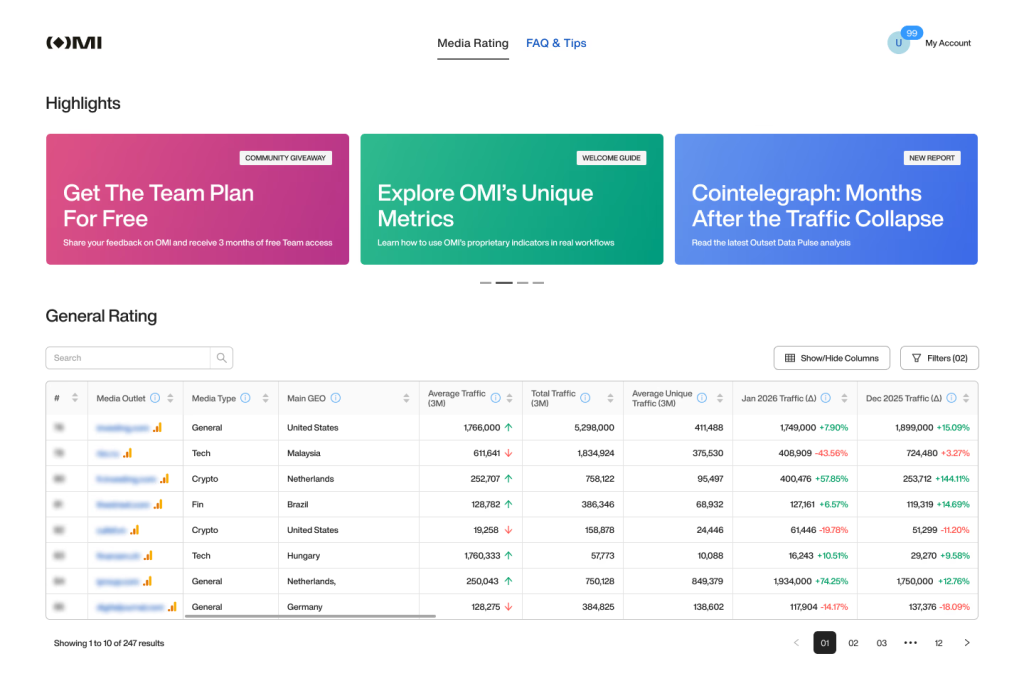
Image sourced from omindex.io
It helps to start with the audience behind the number. Standard scale metrics like Average Traffic, Total Traffic, and Average Unique Traffic (all covered by OMI) show you how big the visitor base looks. What they don’t say is whether those visitors are new each month or part of the group that cycles back through.
The Unique Score is there to clarify these muddy waters. It isolates the three-month unique-visitor base on a normalized scale, so two publications with similar overall traffic can lead to very distinct conclusions. In perspective, that changes what each outlet is useful for. If you’re after reach, you want breadth. If you’re after trust, you want depth.
Where the audience comes from matters just as much as who it is. Similar visit totals don’t mean the reach is identical when one outlet is concentrated in a single market, and another is spread across several regions. In plain terms, a publication drawing most of its readership from Turkey doesn’t behave like one distributing attention across the US, Germany, and the UK, even if both report the same traffic.
OMI’s Main GEO and GEO Breakdown are there to expose this kind of mismatch. The former shows which country supplies the largest share of traffic, while the latter shows the top three regions with their percentages. For anyone weighing outlets by market, those readings can influence the decision.
The Apples-and-Oranges Problem Behind Media Benchmarking
Reach and reader composition are only half of what matters. Another question is whether an outlet is worth working with in the first place, and that’s what media lists and traffic tables rarely address.
Some crypto publications can post impressive traffic numbers while losing most users almost immediately after arrival. A comparison built only on visit counts would treat that performance as a win.
OMI’s Reading Behavior metric catches the difference and combines visit duration, pages per visit, and bounce rate into one score, so media outlets that actually engage people involved stop being lumped in with the one that just attracts clicks.
Next comes a deeper nuance: a website can hold attention really well and still be the wrong fit, because the editorial side after submission counts as much as everything that preceded it.
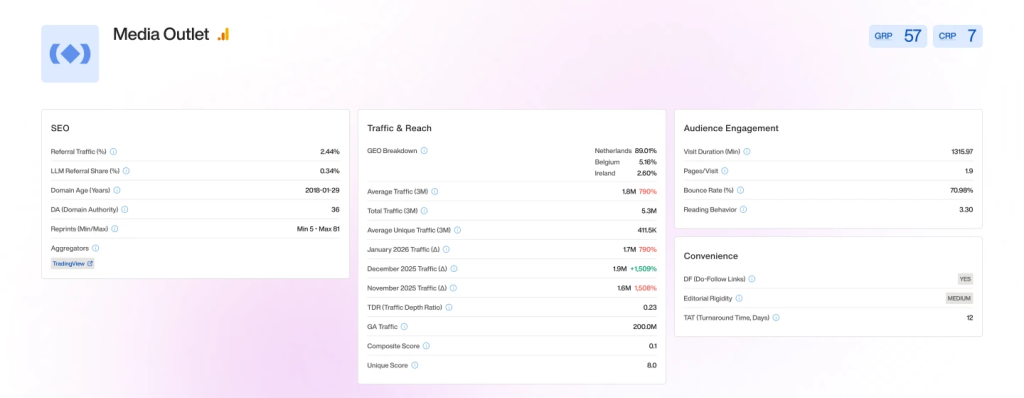
Image sourced from omindex.io
Some publications stay close to the third-party copy, while others tend to rework it heavily. Editorial Rigidity therefore helps separate outlets that allow more freedom in submitted content from those that take full control over narrative engineering.
Sometimes what makes a placeful useful is simply timing. Take crisis management, where early public response may be extremely important to handle a negative situation. Teams need media outlets that react fast rather than make things sit in a queue for weeks. That is what Turnaround Time measures.
None of those readings carries weight unless they’re analyzed consistently across every media outlet, and from outside the outlets themselves.
Again, OMI’s data infrastructure does its job here. The metrics draw on Similarweb, Moz, an internal parser for syndication and reprint signals, plus ongoing analyst research for the parts of media work no existing tool catches.
External sourcing makes sense because sites can’t tilt their own numbers the way reputation-based judgment lets them, which is why OMI functions as a neutral benchmark instead of another version of industry consensus dressed up in data. That keeps the comparison grounded in evidence instead of perception.
Ultimately, if anyone wants to skip a full metric-by-metric breakdown, everything comes down to two final scores: General and Convenience. They compress the normalized signals into a single comparison layer (rated 0-100 and 0-10 respectively), while the underlying performance and workflow metrics remain visible for the actual interpretation.
What This Comes Down To
The old way of reading media still works right up until outlets get treated like they belong in the same bucket. After that, most of the confidence is fake.
Outset Media Index is more useful from that point on. It gives teams a way to analyze differences without reducing everything to just a single name or number.
That is the real role of a benchmarking layer now. Not to simplify media into something tidy, but to stop performance from being reviewed too lazily.
WATCH TOP VIDEOS FROM NIGERIAN TRIBUNE TV
- Relationship Hangout: Public vs Private Proposals – Which Truly Wins in Love?
- “No” Is a Complete Sentence: Why You Should Stop Feeling Guilty
- Relationship Hangout: Friendship Talk 2025 – How to Be a Good Friend & Big Questions on Friendship
- Police Overpower Armed Robbers in Ibadan After Fierce Struggle